



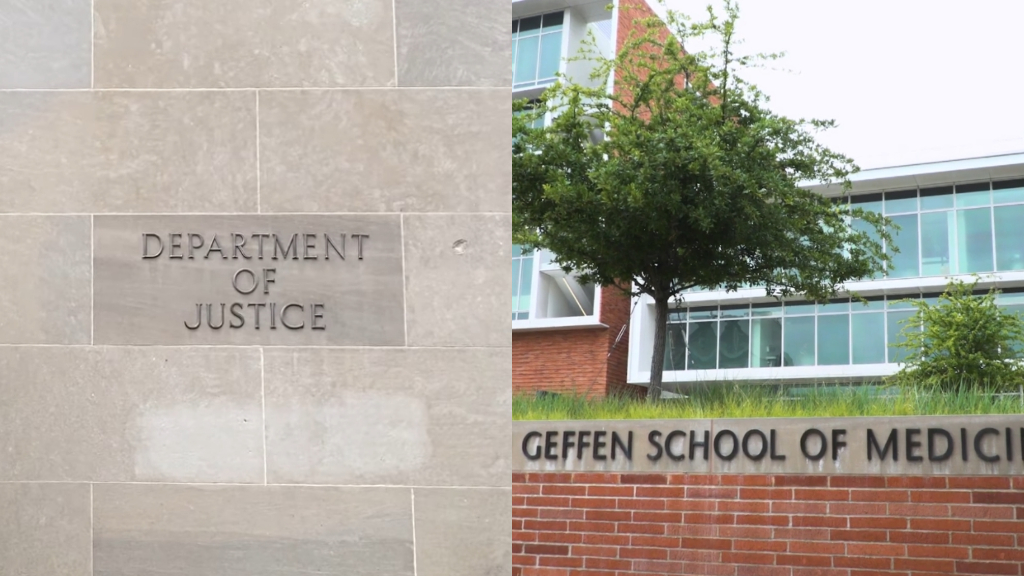
The Department of Justice has sought to join a lawsuit accusing UCLA’s David Geffen School of Medicine of using race as a factor in admissions, allegedly disadvantaging Asian American and white applicants.
Catch up: Students for Fair Admissions (SFFA), which won the 2023 Harvard affirmative action case, filed the suit last May with fellow nonprofit Do No Harm and individual Kelly Mahoney. Mahoney, who is white, scored 519 on the MCAT (96th percentile) with a 3.8 GPA but was rejected. The complaint says the school extracts racial information from essays and interviews under Associate Dean Jennifer Lucero, all while claiming holistic evaluation.
From 2020 to 2023, white and Asian students made up 73% of applicants but admissions dropped from 65.7% to 53.7%, while Black students rose from 8% to 14.29%. Whistleblowers say Lucero “berates and belittles committee members who raise concerns about admitting minority students because of their race despite low GPAs and MCAT scores.”
Latest developments: The DOJ’s 17-page filing last week contends that UCLA uses a “systemically racist approach” that amounts to illegal “racial balancing.” As evidence, the motion reportedly cites four years of MCAT data showing median scores of 506-509 for Black and Latino matriculants versus 513-516 for white and Asian students. The alleged use of race would violate California’s Proposition 209, which banned race preferences at public universities in 1997, and the 2023 Supreme Court ruling.
Why this matters: For Asian American communities, the case tests whether the Supreme Court’s affirmative action ban extends to professional schools. Evidence from undergraduate programs suggests impact. Johns Hopkins, for one, saw Asian American freshmen surge from 26% to 45% between 2023 and 2025, while Harvard grew from 30% to 41%. These shifts appear to validate that race-conscious admissions suppressed representation despite strong credentials. “This was always about the civil rights of Asian parents, having fairness in the system, and not being discriminated against,” activist Yiatin Chu, who celebrated the Supreme Court ruling, told the New York Post.
Still, critics warn that such cases perpetuate a troubling pattern of conservative legal groups leveraging Asian American plaintiffs to dismantle protections for all minorities. Last year, Rep. Grace Meng (D-N.Y.) argued that Asian Americans are being used as “pawns” and wedges between communities of color, while early post-ban data shows Asian enrollment declined at Duke, Princeton and Yale.
Beyond the case: The suit arrives amid broader tensions over California higher education. Last summer, the administration demanded that UCLA pay $1.2 billion and implement changes that would have eliminated race in admissions, ended diversity scholarships and screened international students for “anti-Western” views. However, Judge Rita Lin blocked the penalty in November, finding a “pattern of targeting universities to suppress progressive viewpoints.”
As we have previously reported, polling shows about three in four Asian Americans support affirmative action, yet a smaller subset opposed to such policies appears to have been amplified by right-wing legal networks to undermine diversity measures broadly.
U.S. District Judge John W. Holcomb will hear arguments on the Justice Department’s motion on Feb. 27.
This story is part of The Rebel Yellow Newsletter — a bold weekly newsletter from the creators of NextShark, reclaiming our stories and celebrating Asian American voices.
Subscribe free to join the movement. If you love what we’re building, consider becoming a paid member — your support helps us grow our team, investigate impactful stories, and uplift our community.

Join the conversation+