



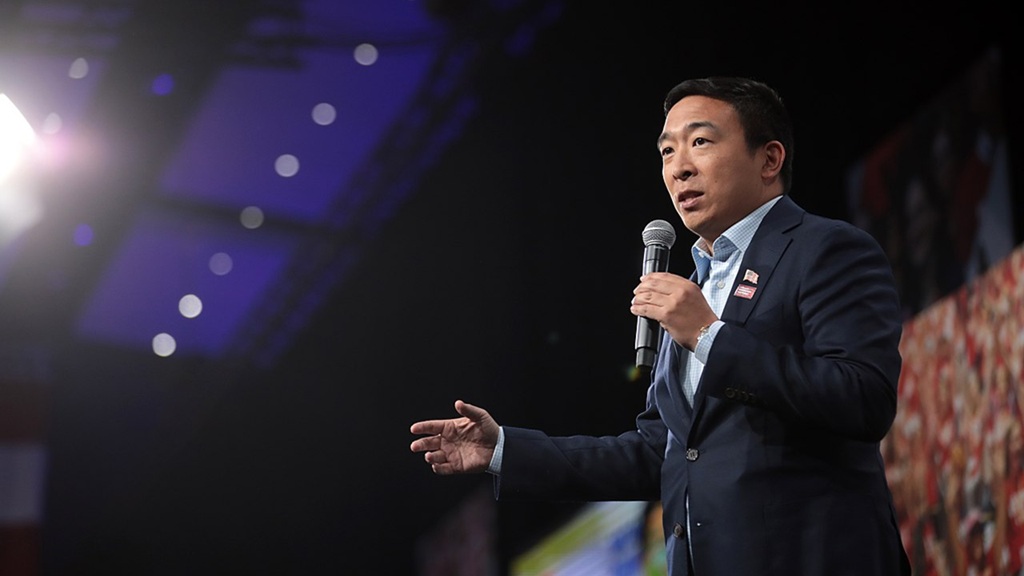
Andrew Yang said his 2020 presidential campaign revealed how issues of technology, economic policy and representation intersect in American politics.
During an interview on Seattle magazine’s “Seattle” podcast released last week, the 51-year-old Taiwanese American entrepreneur and Forward Party co-founder recalled moments when other Asian Americans told him his candidacy made them feel newly visible. He also defended universal basic income, joking that concerns people would stop working miss the point: “I love work. I’m Asian, after all.”
Asian American support
Reflecting on interactions with supporters during the 2020 race, Yang described encounters that illustrated how unusual it still felt for many Asian Americans to see someone who looked like them running for president.
“One family brought their child to take a picture with me in New Hampshire,” he said. “They said, ‘Thank you. I didn’t know we were allowed to run for president.’”
Yang’s candidacy stood out in a crowded Democratic primary field that included more than two dozen contenders. “If you flash back to the 2020 field, there were 24 candidates, the vast majority were white dudes who were members of Congress or even senators or governors,” Yang said. “I used to joke, it’s like, ‘Who’s the Asian guy standing next to Joe Biden and Bernie Sanders.’”
Yang added that cities with large Asian American populations responded strongly to his campaign, including Seattle where he held events during the primary season. “There were a lot of Asian Americans here who were very excited about supporting me,” he said.
In a 2019 op-ed for NextShark, Yang wrote that his presidential run offered an opportunity to show the country that Asian Americans could be “as smart, imaginative, courageous, charismatic and patriotic as any American of any background.”
AI fears meet policy
Yang also touched on his campaign proposal for a universal basic income, which he says was heavily based on the idea that technological advances could eliminate large numbers of jobs across multiple industries.
“AI is going to come and take the jobs,” Yang recalled technology leaders telling him in conversations before he launched his campaign. “My friends in Silicon Valley told me straight up even then that we’re going to be automating away millions of call center jobs and retail jobs and eventually driving jobs.”
Yang said critics often question whether providing Americans with direct payments would reduce their motivation to work. “I think the biggest misconception is that universal basic income is an answer in and of itself,” he said. “One of the most common questions I get is, ‘How do you still give people structure, purpose, fulfillment, community training and value’ because money doesn’t necessarily accomplish all of that.”
According to Yang, economic stability could instead encourage greater community participation and economic activity. “The money in people’s hands would end up supercharging and catalyzing local small businesses and nonprofits and volunteerism and activism and religious communities,” he said, adding that financial insecurity often limits how people engage with civic institutions.
This story is part of The Rebel Yellow Newsletter — a bold weekly newsletter from the creators of NextShark, reclaiming our stories and celebrating Asian American voices.
Subscribe free to join the movement. If you love what we’re building, consider becoming a paid member — your support helps us grow our team, investigate impactful stories, and uplift our community.

Join the conversation+