



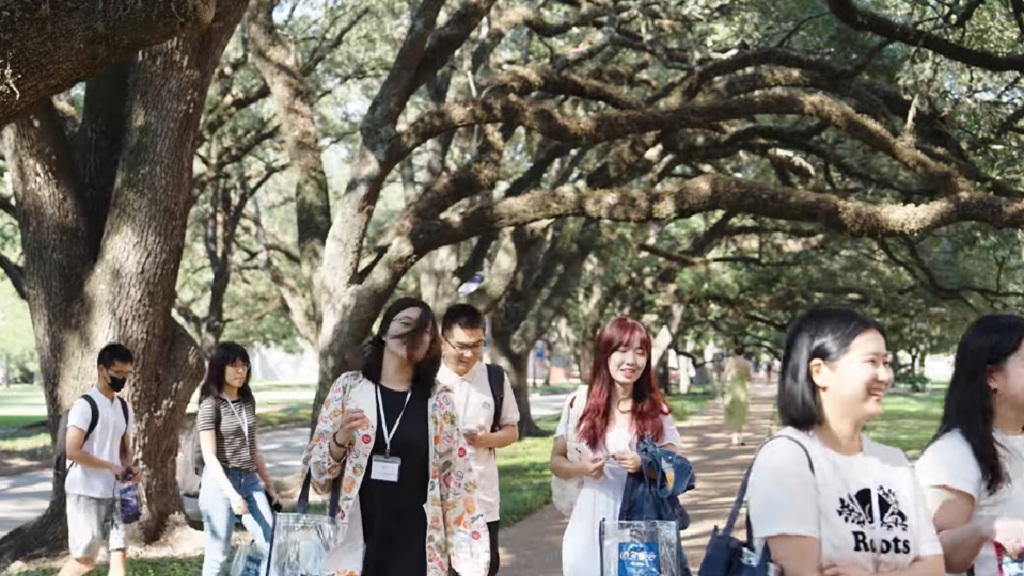
Asian Americans now make up nearly 10% of the Houston metropolitan area, a demographic shift researchers say has quietly reshaped one of the nation’s largest and most diverse cities, according to a study recently released by Rice University’s Kinder Institute for Urban Research. The Asian American Community Study documents how the population grew from roughly 1.8% in 1980 to more than 655,000 residents today across Harris, Fort Bend, Montgomery and Brazoria counties. Researchers describe the change as one of the most consequential demographic transformations in the region’s recent history.
Decades of growth reshape the region
The study traces Houston’s Asian American population growth over more than four decades, showing a steady rise driven by both international immigration and domestic migration. Once a relatively small presence, Asian Americans are now among the fastest-growing demographic groups in the metropolitan area, with significant population increases in Harris, Fort Bend, Montgomery and Brazoria counties. Fort Bend County, in particular, now has the highest proportion of Asian American residents of any county in Texas.
Researchers found that the community is far from monolithic. Indian Americans represent the largest subgroup in the region, followed by sizable Vietnamese, Chinese and Taiwanese, Filipino, Pakistani, Korean and Japanese populations. Over time, Asian American residents have moved beyond a handful of historic enclaves and are now widely distributed across suburban and urban neighborhoods. Roughly two-thirds of Asian American residents are first-generation immigrants, while about one-quarter are second-generation.
Economic range and political complexity
The study highlights wide variation in economic outcomes among Asian American households. Nearly half reported annual incomes above $100,000, while a substantial share reported much lower earnings. Researchers note that high average income figures can obscure pockets of economic insecurity within the broader population.
Meanwhile, survey responses showed no dominant party affiliation, with Asian Americans identifying as Democrats, Republicans and independents in roughly comparable proportions. Many respondents described themselves as politically moderate, suggesting that partisan alignment remains fluid and shaped by a mix of local issues, national politics and personal experience.
Discrimination, identity and belonging
Despite indicators of economic integration, the study found that discrimination remains a common experience. About four in 10 respondents reported facing bias or unequal treatment based on race or ethnicity, with younger adults reporting such experiences more frequently than older residents. Researchers caution that demographic growth alone does not eliminate social barriers or perceptions of exclusion.
Rather than identifying with a single, unified community, many respondents described navigating cultural identity across multiple settings such as family, work, religion and education. Researchers say this reflects both the diversity within Asian American populations and the broader complexity of life in a highly diverse metropolitan area. They intend to conduct future analyses that will examine education, health outcomes and civic participation.
This story is part of The Rebel Yellow Newsletter — a bold weekly newsletter from the creators of NextShark, reclaiming our stories and celebrating Asian American voices.
Subscribe free to join the movement. If you love what we’re building, consider becoming a paid member — your support helps us grow our team, investigate impactful stories, and uplift our community.

Join the conversation+