



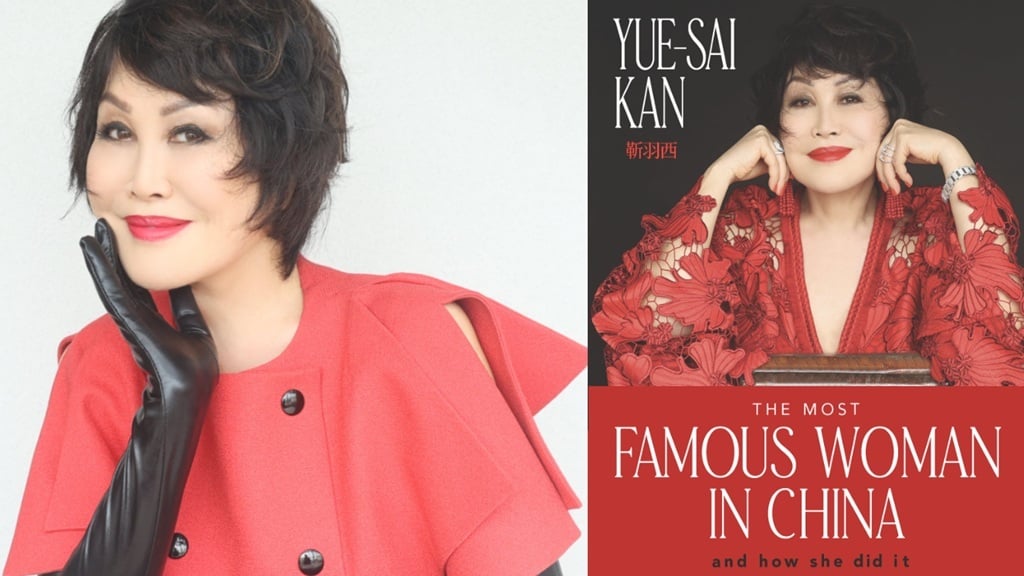
Yue-Sai Kan introduced the world to China when the country was still largely closed off. Now, she worries that understanding is slipping away. In her new memoir, “The Most Famous Woman in China,” Kan revisits the years when she helped shape the country’s global image and offers a firsthand account of a nation on the cusp of irreversible change.
When Yue-Sai Kan arrived in mainland China in the 1980s, the country was visually monochromatic. The Cultural Revolution had left a legacy of uniformity. Men and women alike wore blue and gray Mao suits. Bicycles crowded the roads where cars were non-existent.
In an interview with The Rebel Yellow, Kan recalls that “the wealthiest person I met was making $12 a month.” It was an era of scarcity where a dress was expected to have a nine-year lifespan. As the saying went: “three years new, three years old, and three years patched.”
Against this backdrop, Kan was a shock of color.
Through her television series, “One World,” she became the primary interpreter of the West for 400 million Chinese viewers. At a time before the internet, her broadcasts were the only window many had into life outside their borders. She walked them through New York streets and European capitals to explain a world that had been forbidden for decades.
Now, the woman once dubbed “the most famous woman in China” by Western media is revisiting that era in a new memoir. The book blends cultural history with autobiography, following her trajectory from a young immigrant to a national figure who helped usher China into global consciousness. She notes that the most important part of the title isn’t the fame, but the subtitle: “and how she did it.”
The era of misunderstanding
A sense of urgency drove the project, as Kan believes the bridge she helped build is cracking. She argues that despite China’s rise to economic superpower status, the West’s grasp of the country has deteriorated.
“Today, there is such a lack of true understanding of China, what has really happened there over the last 40 years,” she says.
Her memoir serves as a corrective to the current headlines. It traces the arc from a closed society to a global powerhouse and uses her own life as the evidence. She notes that “the transformation of 1.4 billion people in just four decades will never be repeated in history.”
She insists the book is “not only my story. It is the story of modern China.”
Changing the face of a nation
Kan’s impact went deeper than television ratings. After introducing the world to China, she turned her attention to how Chinese women saw themselves.
She launched a cosmetics brand in a country where makeup had effectively been banned for a generation. It was a risky move. She was asking women to reclaim a sense of individuality that had been politically suppressed. The gamble worked. Her brand became a household name, and she inadvertently sparked a shift in the country’s visual culture.
Looking back, Kan credits her father for this appetite for risk. He told her to “be the first man to land on the moon,” which she took as a directive to seek out unoccupied spaces.
Writing the book forced her to confront the personal cost of that ambition. Born in China and raised in Hong Kong, Kan left for Hawaii at 16 to study piano before establishing a media career in New York City. She recounts that period as one defined by profound loneliness. Yet that isolation forged the empathy required to navigate between two vastly different cultures. By the time she returned to mainland China, she possessed a rare dual vision: she understood the traditions she had left behind and the American dynamism she had adopted.
It was only recently, while touring for the book, that she fully grasped the weight of that work. “Hearing how my life touched theirs was a powerful surprise,” she says of meeting scholarship recipients and fans. “Perhaps what moved me most was realizing that in some way, my journey had changed theirs.”
The next generation
The landscape has changed since Kan’s early days. She notes the rise of Asian and Asian American women in media and business, spaces where she once stood alone. “When I began, there were almost no Asian women visible in media, business, or philanthropy,” she says.
Yet, she sees the same questions of identity playing out for this new generation. Her advice is to embrace this duality. She believes “you can be proudly Asian and fully global at the same time; rooted in heritage, yet unafraid to lead on the world stage.”
Today, Kan operates through her foundation and the China Institute in America, which is approaching its 100th anniversary. She funds cultural literacy programs and recently launched a Chinese culinary center. It is slower work than broadcasting to millions, but she views it as essential maintenance for international relations.
It is a mission fueled by a simple philosophy. “Life is both fragile and powerful,” she says. “Once you discover your talents, use them wisely. Not only for yourself, but to uplift others.”
This story is part of The Rebel Yellow Newsletter — a bold weekly newsletter from the creators of NextShark, reclaiming our stories and celebrating Asian American voices.
Subscribe free to join the movement. If you love what we’re building, consider becoming a paid member — your support helps us grow our team, investigate impactful stories, and uplift our community.

Join the conversation+