



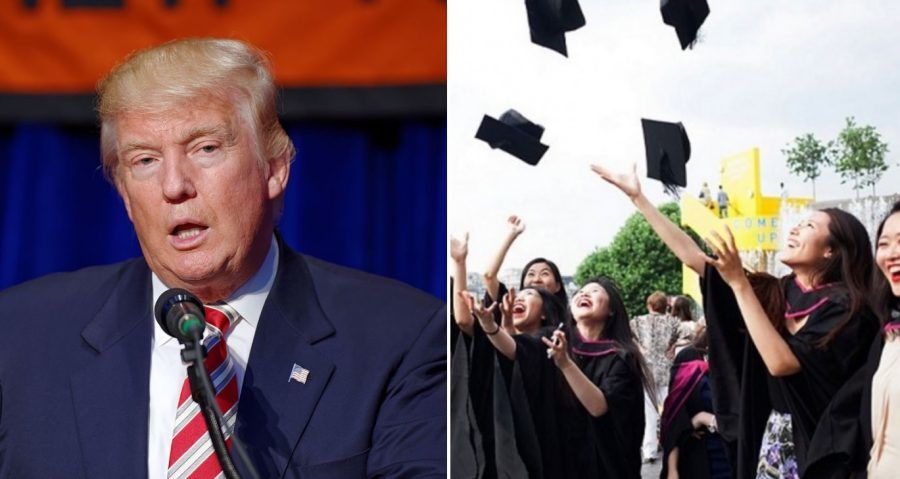
Earlier this week, Donald Trump announced that he wanted to investigate “race-based discrimination” against some college applicants, even going as far as preparing to redirect financial resources to the investigation. The administration’s aim is to determine if the policies are unfairly refusing admittance to students based on their racial background.
Affirmative Action was first referenced in an official capacity in the U.S. as an executive order signed by John F. Kennedy in 1961, mandating that government contractors to “take affirmative action to ensure that applicants are employed, and that employees are treated during employment, without regard to their race, creed, color, or national origin” (Executive Order 10925). Under the Civil Rights Act of 1964, government organizations and organizations that received funding for the government had to prove, with metrics, that they were not hiring based off discriminatory practices. Eventually, this evolved into policies adopted by other organizations, such as private companies and universities. This was to ensure that people of all races (non-Whites, but in the context of U.S. politics it was aimed at helping predominately Blacks) could have an equal chance at educational and employment opportunities.
While Affirmative Action has had positive outcomes for some of the minorities they aimed to assist, critics say that there have been negative consequences for other racial groups. While the most obvious group to be vocal about the policy would appear to be Whites, concerns have arisen from a number of Asian-Americans as well, specifically in the case of college admissions.
“The civil rights laws were deliberately written to protect everyone from discrimination, and it is frequently the case that not only are whites discriminated against now, but frequently Asian-Americans are as well,” said Roger Clegg, a former top official in the civil rights division during the Reagan administration and the first Bush administration. He is now the president of the conservative Center for Equal Opportunity and considers the investigation “long overdue”.

In an article by the L.A. Times, Joe Zhou, father of a son who was rejected from Harvard despite his “near-perfect ACT and SAT scores, a 4.44 grade-point average, being named class valedictorian, and a resume that included teaching English in China and serving as captain of the varsity tennis team”, was elated by the Trump administration’s position. “Maybe now people will finally pay attention to something we Asian Americans have been talking about for so long,” he said of the news.
Asian-Americans like Zhou believe that Affirmative Action in this specific regard has done more harm than good for their demographic; if admittance is based on filling quotas and not on merit, they feel their chances of being accepted decrease, their deserved slots going to less-qualified people of other racial groups (Whites included).
However, not all Asian-Americans agree with this stance; a recent poll found that only 25% of Asian-Americans are opposed to Affirmative Action, with support for it being the lowest among Chinese-Americans at 41%.
Many Asian-Americans who support Affirmative Action feel that focusing on just the university admittance aspect is dangerous and that ditching the policy altogether will have negative consequences for life after college.

“I don’t see…concern about discrimination against Asian Americans in other contexts, such as the “bamboo ceiling” in corporate America, where such discrimination does not harm white interests” said Kim Forde-Mazrui, a University of Virginia law professor who specializes in race. And although the Trump administration is looking into any possible discrimination in university admittance procedures, Forde-Mazrui remains skeptical of just how much the investigation will actually help Asian-Americans. “This is primarily about conservative leaders protecting the privilege of access to society’s resources and opportunities for certain white constituents,” he said.
The Department of Justice has cited Zhou’s lawsuit against Harvard and similar lawsuits filed by over 64 different Asian groups as the reason behind their investigation. However, the lawsuits allege first-hand accounts of discriminatory admittance practices against Asian-Americans, with little-to-no references to discriminatory practices against Whites. Despite this, the concern for “race-based discrimination” in this context has some worried that the administration will focus on the plight of the White students and only on the Asian-American students when it benefits their Caucasian counterparts.
Forde-Mazrui agrees. “Such leaders’ purported concern for discrimination against Asian Americans is politically opportunistic.”

Join the conversation+