



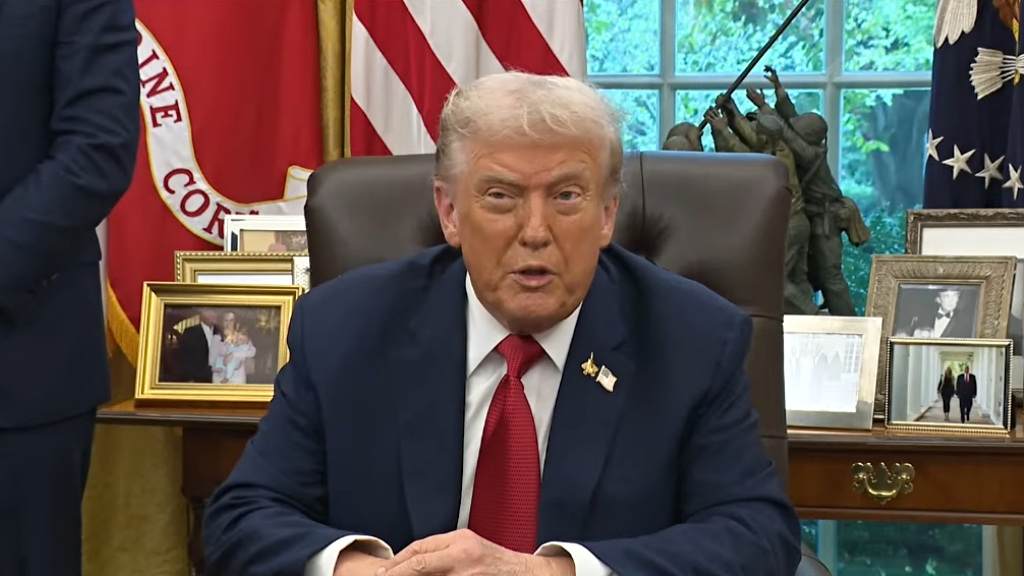
After the Supreme Court ruled 6-3 on Friday that President Donald Trump exceeded his authority in imposing sweeping tariffs under a 1977 emergency law, Trump vowed to use other legal powers to escalate his trade war.
Latest developments: Friday’s ruling struck down tariffs Trump had imposed under the International Emergency Economic Powers Act (IEEPA), including reciprocal tariffs on specific trading partners and a 25% duty on some goods from Canada, China and Mexico linked to fentanyl flows. In response, Trump announced a new 10% global tariff at a Friday afternoon news conference under Section 122 of the Trade Act of 1974, a separate legal authority, and raised that rate to 15% the following day, the maximum permitted under that statute.
In retaliation, Trump called the majority justices “fools and lap dogs” and suggested Justices Neil Gorsuch and Amy Coney Barrett were “an embarrassment to their families” for ruling against him. Meanwhile, stocks had rallied Friday on news of the ruling, but equity futures and the dollar weakened Monday as uncertainty over the administration’s trade plans deepened.
Driving the news: The 6-3 decision is a rare check on Trump’s executive power at a court where his party’s appointees hold a supermajority. It is also the first time a president who used IEEPA to impose tariffs has been struck down for doing so. Writing for the majority, Chief Justice John Roberts invoked the “major questions doctrine,” finding that nothing in IEEPA’s text gave the White House unilateral power to levy tariffs, though the court’s three liberal members joined the outcome on separate grounds. The ruling also carries significant financial consequences, as the now-struck-down IEEPA tariffs had generated roughly $130 billion in revenue, and lower courts must still determine how businesses can seek refunds on those payments.
Despite the ruling, the White House signaled no intention to back down, with U.S. Trade Representative Jamieson Greer declaring Sunday that “the policy hasn’t changed.” Sens. Chuck Grassley and Mitch McConnell, however, broke with the administration, welcoming the ruling and calling on Congress to reclaim its authority over trade policy.
What this means for Asian Americans: The ruling offers uncertain relief for AAPI communities long burdened by high import costs. Grocers serving these communities had faced duties running from 15% on South Korean imports to 50% on goods from India, with no domestic substitutes for many specialty products and profit margins as thin as 2%. Unsurprisingly, those pressures had already pushed some businesses to close. One was Yue Wa Market in Los Angeles’ Chinatown, whose owner pointed to tariffs and escalating rent, while local ICE operations drove away customers and theft compounded her losses.
The outlook is similarly uncertain for Asian trading partners. Trump’s new 15% rate is lower than the IEEPA tariffs many Asian nations had faced, but countries that negotiated reduced rates with Washington, including Indonesia and Taiwan, are now unsure whether those deals will survive the legal upheaval.
Trump’s 15% tariff takes effect Tuesday under a temporary legal authority requiring congressional approval within five months.
This story is part of The Rebel Yellow Newsletter — a bold weekly newsletter from the creators of NextShark, reclaiming our stories and celebrating Asian American voices.
Subscribe free to join the movement. If you love what we’re building, consider becoming a paid member — your support helps us grow our team, investigate impactful stories, and uplift our community.

Join the conversation+