



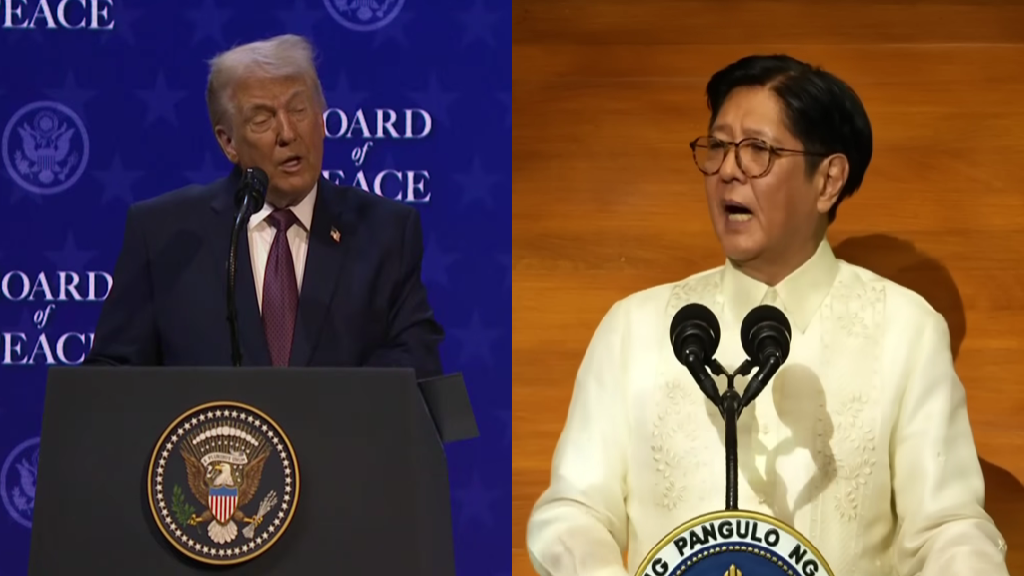
The Philippine government is reviewing whether to participate in the so-called Board of Peace following a reported personal invitation from President Donald Trump to President Ferdinand R. Marcos Jr., the son of the late Philippine dictator whose family ruled the country for two decades. Philippine officials confirmed in Manila this month that the proposal involves a Gaza-focused body operating outside the United Nations and existing ceasefire mechanisms. Officials familiar with the discussions said the board has yet to issue formal terms of reference or clarify how member states would exercise authority.
Structure, cost and control
Trump launched the Board of Peace at the World Economic Forum in Davos in January, initially presenting it as a mechanism to oversee the Gaza ceasefire and postwar reconstruction before expanding its stated mission to broader global stability. Under the board’s charter, Trump serves as both permanent chairman and the US representative, with exclusive authority to create, modify or dissolve its entities and removal possible only through voluntary resignation or incapacity. Permanent membership requires a $1 billion contribution, and the initiative is set to move from concept to practice with its inaugural meeting scheduled in Washington on Feb. 19, where organizers have said fundraising for Gaza reconstruction will be a central focus.
Philippine Ambassador to the U.S. Jose Manuel Romualdez confirmed that the invitation was conveyed through a letter addressed directly to Marcos and that no commitment has been made. Speaking to reporters in Manila, Romualdez said the government was “looking at what kind of commitment is being asked of us,” including whether participation would involve financial contributions or operational responsibilities. He added that officials were proceeding cautiously given the board’s lack of institutional backing and clearly defined governance.
Divided international reception
Some of the strongest pushback has come from major powers wary of any structure that could rival the United Nations. China has rejected the notion that the board could supersede existing multilateral institutions, with its Foreign Ministry reaffirming that Beijing will uphold the UN Charter regardless of changes in the international environment. Invitations were also extended to Russian President Vladimir Putin and North Korean leader Kim Jong Un, neither of whom has publicly accepted or declined, although Putin confirmed receiving the invitation and said Moscow would review it, linking any potential $1 billion contribution to the unfreezing of Russian assets held in the U.S.
France, Italy, Norway, New Zealand and Croatia have declined to join, while Romania’s president said participation would depend on revisions to the board’s charter. Argentina’s President Javier Milei and Hungary’s Prime Minister Viktor Orban have confirmed plans to attend the board’s inaugural meeting.
This story is part of The Rebel Yellow Newsletter — a bold weekly newsletter from the creators of NextShark, reclaiming our stories and celebrating Asian American voices.
Subscribe free to join the movement. If you love what we’re building, consider becoming a paid member — your support helps us grow our team, investigate impactful stories, and uplift our community.

Join the conversation+