



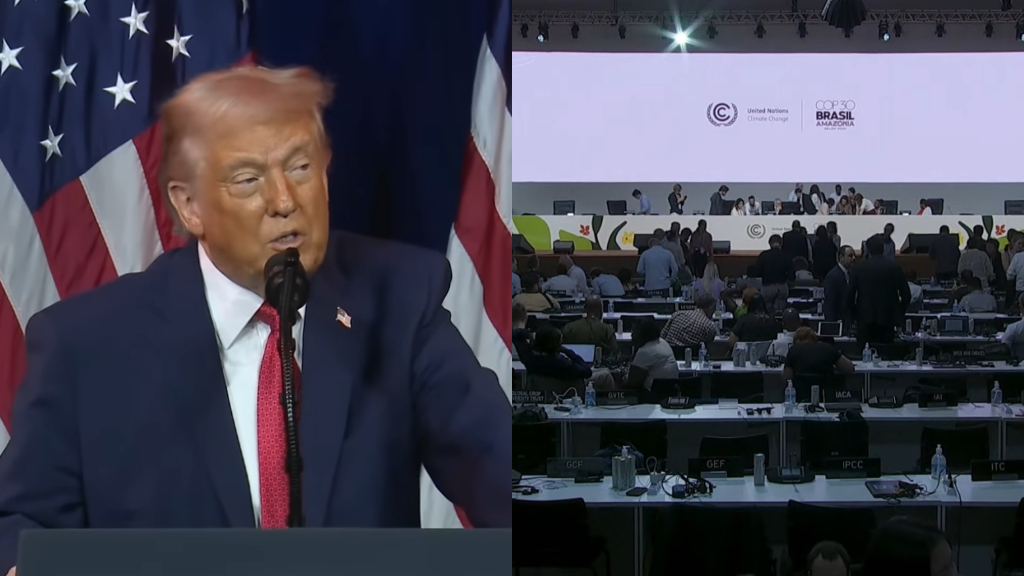
President Donald Trump directed the U.S. to withdraw from the United Nations Framework Convention on Climate Change (UNFCCC) last week, marking the only nation to exit the 1992 treaty that underpins global climate cooperation.
Multiple exits: Trump’s Jan. 7 memorandum orders American withdrawal from the UNFCCC alongside 65 other international bodies. In a statement defending the decision, Secretary of State Marco Rubio said the government will not continue “expending resources, diplomatic capital, and the legitimizing weight of our participation in institutions that are irrelevant to or in conflict with our interests.” The directive also targets the Intergovernmental Panel on Climate Change (IPCC), as well as the International Renewable Energy Agency (IRENA) and International Solar Alliance (ISA).
The action raises significant legal questions, however. Congress ratified the treaty with unanimous Senate consent in October 1992 when George H.W. Bush was president, leading some legal scholars to argue Trump cannot act unilaterally.
Why this matters: The withdrawal threatens to exclude the U.S. from climate diplomacy for decades while potentially encouraging other nations to weaken their commitments. Most critically, a future administration seeking to rejoin the Paris Agreement would face major hurdles, since that accord was negotiated under the UNFCCC framework. Legal experts remain divided on what re-entry would require. Some argue a new two-thirds Senate majority would be necessary, while others believe the original 1992 approval still stands.
The timing also reveals troubling contradictions. Property insurers have exited multiple states due to escalating disaster risks, and 2025 reportedly ranked as either the second or third hottest year on record. Trump announced the withdrawal exactly one year after Los Angeles wildfires killed dozens and destroyed thousands of homes.
Broader implications: The withdrawal gives China significant advantages in the global clean energy sector while forfeiting trillions in economic opportunities. Former U.S. climate envoy John Kerry told CNN it was “a gift to China and a get out of jail free card to countries and polluters who want to avoid responsibility.”
Beyond immediate economic impacts, environmental economist Gary Yohe warns the withdrawal may give other countries justification to reduce their climate efforts while eliminating U.S. participation in negotiations where China has been expanding its influence. For Asian American communities focused on transpacific cooperation, this represents a broader pattern of American retreat from collaborative international engagement on climate and other critical issues.
The withdrawal becomes official one year after notification, leaving unresolved questions about possible legal challenges and pathways for future U.S. re-entry.
This story is part of The Rebel Yellow Newsletter — a bold weekly newsletter from the creators of NextShark, reclaiming our stories and celebrating Asian American voices.
Subscribe free to join the movement. If you love what we’re building, consider becoming a paid member — your support helps us grow our team, investigate impactful stories, and uplift our community.

Join the conversation+