



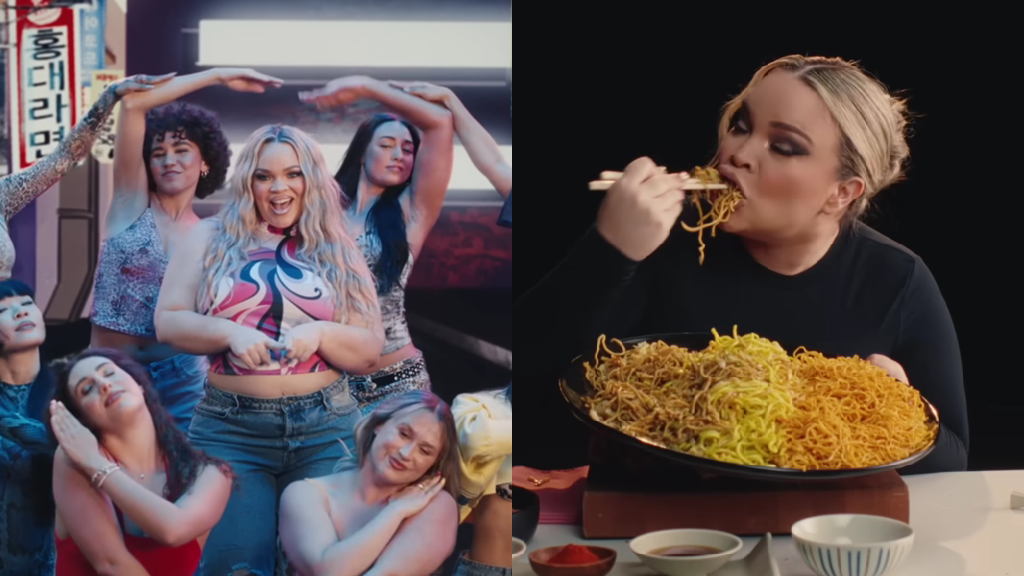
Internet personality Trisha Paytas drew backlash this week after critics resurfaced a 2017 tweet containing anti-Asian slurs days after she released a Korean-language pop single styled after mainstream K-pop videos.
The 38-year-old American creator of Hungarian descent released “Saranghae” on May 18 with Korean lyrics, synchronized choreography, Korean street food scenes and other South Korean imagery. As the song spread across TikTok and X, users circulated screenshots of a tweet attributed to Paytas that read, “I’m Asian ching chong ching chong wong srry my engrish is bad,” alongside older clips in which she said, “We’re for Israel, not Palestine.”
Inside the “Saranghae” rollout
Paytas’ “Saranghae” video adopted visual elements associated with contemporary K-pop releases, including coordinated dance choreography, Korean signboards and Seoul landmark imagery. The song, which runs just over two minutes, was written and produced by Danbi Kim, Amy L. Stillwell and Alex Wright.
Paytas later said on Instagram that her children’s interest in K-pop inspired the project, writing, “Performing a song entirely in Korean was a huge challenge. I’m grateful to the songwriter and producer who patiently taught me the meanings and nuances embedded in this beautiful language and culture.”
Older controversies resurface
As criticism surrounding the song intensified, users also reposted older clips and screenshots tied to Paytas’ comments about Israel and Palestine. One widely circulated clip showed Paytas saying, “We’re for Israel, not Palestine,” during a conversation with her husband Moses Hacmon, an Israeli artist and photographer whom she married in 2021. Critics also pointed to older posts involving Israel-related imagery, including an Israel Defense Forces uniform costume.
Paytas has previously drawn backlash over videos and statements involving race, religion, gender identity and mental health. Paytas had not publicly addressed the resurfaced tweet in connection with the rollout as of publication.
A longtime reinvention strategy
Paytas has repeatedly rebuilt her online persona through new music releases, viral controversies and identity-based reinventions across YouTube, TikTok and reality television. Since gaining popularity in the late 2000s through emotional vlogs and provocative content, she has released dozens of singles spanning pop, country and religious-themed music while maintaining a large audience built around internet spectacle and personal disclosure.
“Saranghae” marked one of her most visible attempts to align with Korean pop aesthetics at a time when K-pop continues expanding globally beyond Asian audiences.
This story is part of The Rebel Yellow Newsletter — a bold newsletter from the creators of NextShark, reclaiming our stories and celebrating Asian American voices.
Subscribe free to join the movement. If you love what we’re building, consider becoming a paid member — your support helps us grow our team, investigate impactful stories, and uplift our community.

Join the conversation+