



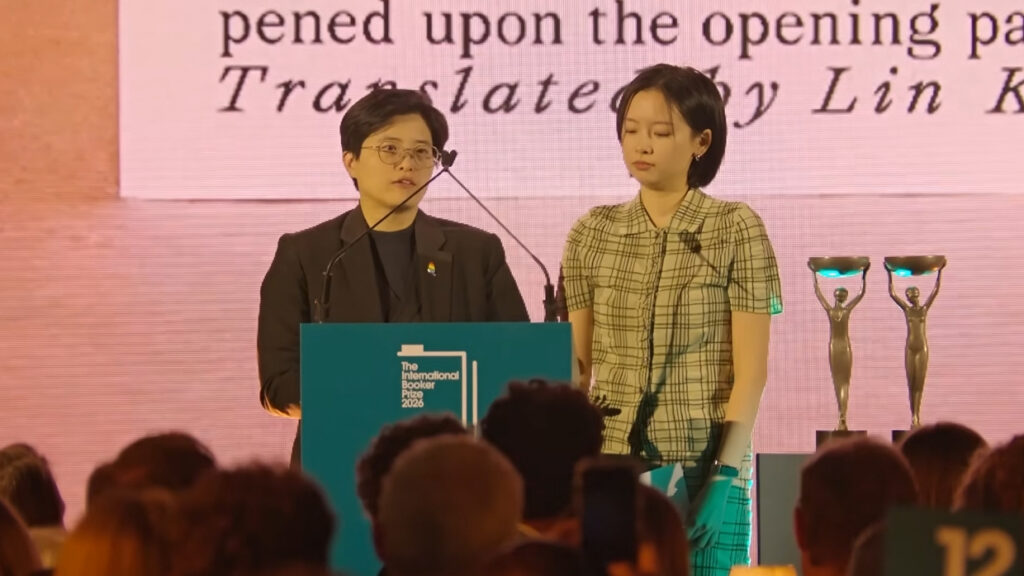
Yáng Shuāng-zǐ and translator Lin King’s queer colonial romance has become the first Mandarin Chinese work to win one of fiction’s most prestigious international honors last week.
A love story layered in colonial history
Set in 1938 Japan-occupied Taiwan, “Taiwan Travelogue” centers on Aoyama Chizuko, a young Japanese novelist on a government-sponsored tour of the island, and Chizuru, the enigmatic Taiwanese interpreter assigned to accompany her. As Chizuko grows infatuated, Chizuru keeps her at arm’s length. The novel is disguised as a recovered Japanese travel memoir, with its metafictional framework built from fictional introductions, footnotes and afterwords alongside real ones by King. This created what judging chair Natasha Brown described as “an intriguing metafictional layer around its core love story.”
Originally published in Mandarin in 2020, the book claimed Taiwan’s Golden Tripod Award, the self-governed island’s top literary honor. King’s English translation followed with the 2024 National Book Award for translated literature. Selected from 128 submitted titles with six shortlisted, the work earned the 50,000 pound prize (worth roughly $67,000), divided equally between author and translator.
Behind the work
Yáng has built a career spanning fiction, essays, manga and video game scripts, but “Taiwan Travelogue” marks her English-language debut. On the other hand, King, a Taiwanese American writer based in Taipei and New York, has a debut novel, “Weeb,” forthcoming from Holt. Together, they became the first Taiwanese and Taiwanese American winners in the International Booker’s 10-year history.
Yáng drew a direct line between literature and politics at the award ceremony at London’s Tate Modern last Tuesday. “Literature cannot be separated from the soil in which it has grown,” she said before asking, “What kind of future do the people of Taiwan want?” Meanwhile, King said Russia’s full-scale invasion of Ukraine had led her to commit to translating Taiwanese writing exclusively, saying, “We are not a chorus but a cacophony, self-contradicting and unruly, just like any healthy, robust democracy.”
Why this matters
The novel interrogates a historical tension many Taiwanese Americans know too well. Yáng has noted that Korean and Taiwanese responses to Japanese colonial rule diverge sharply: Koreans seem to feel uniformly resentful, whereas Taiwanese people more often hold a “conflicted mix of distaste and nostalgia.” King was committed to depicting colonized peoples with full complexity, cautioning that to do otherwise is to “reduce a culture to its trauma.”
Both convictions appear evident in a book that resonates with many Asian American readers. As a queer love story between two Asian women, rooted in a colonial past rarely examined in Western literary spaces, “Taiwan Travelogue” shows that Asian diasporic histories can achieve major international recognition. The win also marks the second consecutive year that independent U.K. press And Other Stories has taken home the prize.
“Taiwan Travelogue” is available now from And Other Stories in the U.K. and Graywolf Press in the U.S.
This story is part of The Rebel Yellow Newsletter — a bold newsletter from the creators of NextShark, reclaiming our stories and celebrating Asian American voices.
Subscribe free to join the movement. If you love what we’re building, consider becoming a paid member — your support helps us grow our team, investigate impactful stories, and uplift our community.

Join the conversation+