



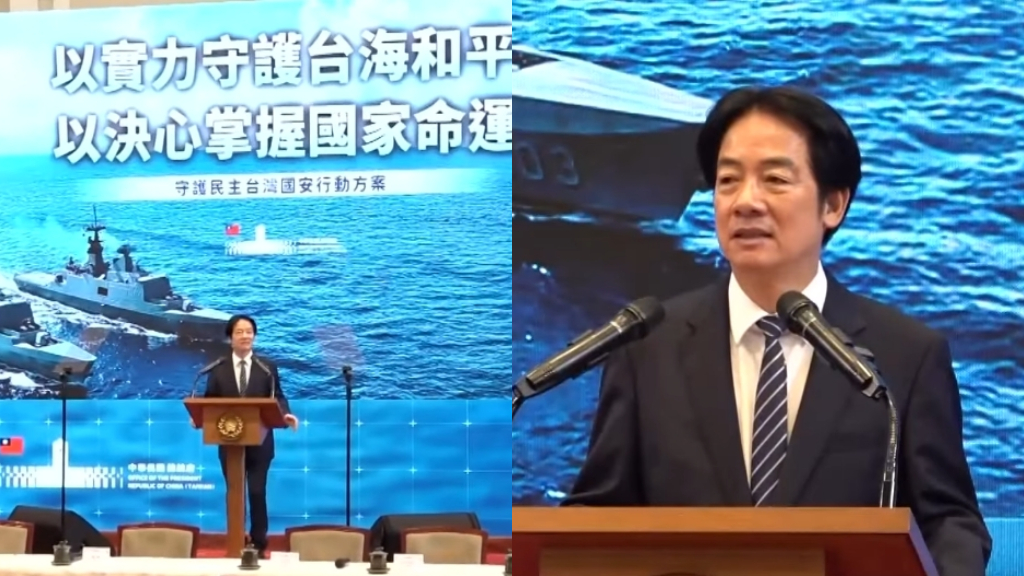
President Lai Ching-te unveiled Taiwan’s most ambitious military spending program last week, committing $1.25 trillion Taiwan dollars ($40 billion) over eight years to bolster the island’s defenses as Beijing intensifies pressure and cross-strait relations grow increasingly precarious.
Meeting the deadline: The self-governed island’s defense buildup directly responds to intelligence indicating that China’s government has targeted 2027 to complete military preparations for potential forced reunification. This deadline has shaped regional military planning in recent years following Beijing’s repeated declarations that it would pursue unification by force if necessary. Earlier this year, U.S. Defense Secretary Pete Hegseth publicly confirmed that American intelligence shows Xi has ordered the People’s Liberation Army to achieve readiness for a Taiwan operation by 2027.
The $40 billion funding will support three core capabilities: (1) the T-Dome, a multi-layered air defense system; (2) the integration of artificial intelligence and advanced technologies for rapid decision-making and precision strikes; and (3) expanded domestic weapons production to strengthen both security and the economy. Beyond the military hardware, Lai introduced measures to protect Taiwan’s democracy, including a permanent task force to counter Beijing’s efforts to rebrand the island internationally as “Taiwan, China” rather than a separate entity. Drawing historical parallels, he warned that appeasing aggressors brings only war and oppression, citing Czechoslovakia’s territorial concessions to Nazi Germany in 1938 and Tibet’s 1951 agreement with Beijing.
Shifting regional dynamics: Taiwan’s announcement comes amid deteriorating Japan-China relations triggered by Tokyo’s unprecedented, explicit position on defending Taiwan. Prime Minister Sanae Takaichi, who was elected last month, recently told lawmakers that Chinese military action against Taiwan could threaten Japan’s survival and trigger a military response from Tokyo. China responded by escalating the dispute to the United Nations, warning its citizens against traveling to Japan and imposing economic penalties on Japanese seafood, films, concerts and other sectors. Last Monday, Beijing condemned Tokyo’s plans to deploy missiles on islands near Taiwan as intentionally stoking regional tensions. Japan, in response, scrambled a fighter jet after detecting a Chinese drone flying between Taiwan and its Yonaguni Island.
Trump, for his part, held phone calls last Monday with both Xi and Takaichi, during which Xi emphasized his view that Taiwan’s “return to China” represents a fundamental part of the post-World War II international order. Trump’s social media statement about the Xi call described U.S.-China relations as “extremely strong” but made no mention of Taiwan. Despite this public silence, the Trump administration has approved two arms sales to Taiwan since January, a nearly $700 million advanced missile system and $330 million in fighter jet and aircraft parts.
The ambiguity doctrine: For years, most U.S. presidents have declined to state whether the U.S. would defend Taiwan militarily against a Chinese attack. This is a policy of “strategic ambiguity” designed to deter Beijing from aggression while discouraging Taipei from declaring formal independence. Trump has maintained this approach throughout both his administrations, telling CBS when asked whether he would deploy American forces to defend Taiwan: “You’ll find out if it happens. And he understands the answer to that.” However, this ambiguity carries costs for Taiwan’s public morale, according to Lev Nachman, who teaches political science at National Taiwan University. “Whether or not we believe America is coming or not has a very big effect on people’s willingness to defend Taiwan,” he told the Wall Street Journal.
Taiwan’s commitment to 5% GDP in defense spending by 2030 directly addresses Trump administration demands for greater allied self-funding of security. Hegseth emphasized this expectation at the Shangri-La Dialogue in Singapore, calling on Indo-Pacific partners to increase defense budgets to 5% of GDP and citing NATO benchmarks as a model. Lai said last Wednesday that bilateral cooperation has proceeded continuously during Trump’s second term and characterized U.S.-Taiwan ties as “rock solid.” The spending plan reflects concerns rooted in Trump’s previous warnings that Taiwan would be “next” following Russia’s Ukraine invasion, with Trump saying that Xi was watching “with glee” and seeing “his opportunity to do what he wants to do.”
What this means: These tensions carry particular weight for Asian American communities, especially the over 300,000 Taiwanese Americans who maintain family and cultural ties to Taiwan. Needless to say, the prospect of military conflict raises concerns about relatives’ safety, economic disruption and community stability. Taiwan’s semiconductor industry also produces over 60% of the world’s chips and more than 90% of the most advanced processors, making the island’s security critical to American economic and technological infrastructure. A conflict across the Taiwan Strait would severely disrupt supply chains for consumer electronics, automobiles and defense systems.
The crisis extends beyond Taiwanese American communities. Takaichi’s explicit commitment to defend Taiwan marks a fundamental shift from Tokyo’s traditional approach to cross-strait issues, and Beijing’s economic retaliation shows how quickly geopolitical tensions can affect diaspora communities and international relationships. Meanwhile, Chinese Americans must navigate competing narratives about sovereignty and governance, with Beijing asserting that Taiwan has always been an inalienable part of China.
Taiwan Premier Cho Jung-tai said last week that for Taiwan’s 23 million people, “there was no option of returning” to China, emphasizing that the Republic of China, the island’s formal name, is “a fully sovereign and independent nation.”
This story is part of The Rebel Yellow Newsletter — a bold weekly newsletter from the creators of NextShark, reclaiming our stories and celebrating Asian American voices.
Subscribe free to join the movement. If you love what we’re building, consider becoming a paid member — your support helps us grow our team, investigate impactful stories, and uplift our community.

Join the conversation+