



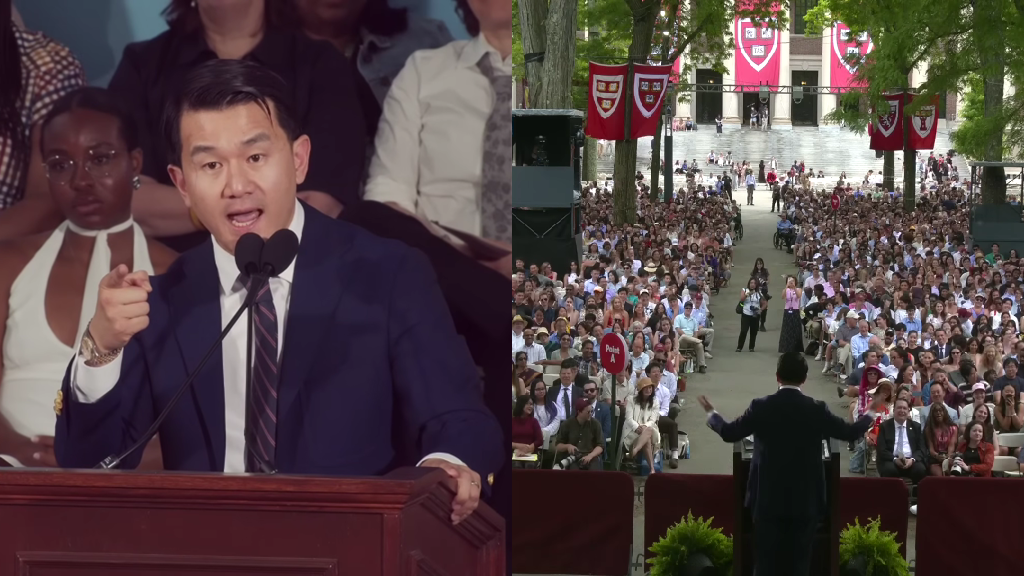
Ronny Chieng used Harvard College’s Class Day ceremony this week to openly mock the pro-AI message that has shaped many commencement speeches across the U.S. The comedian and “Daily Show” correspondent drew loud applause Tuesday after repeatedly saying “fuck AI” and telling students their generation’s mission was to “destroy AI” instead of “master AI for the future.”
The remarks stood out at Harvard, whose alumni include Meta CEO Mark Zuckerberg and Microsoft CEO Satya Nadella and whose graduates remain heavily recruited by Silicon Valley firms and AI startups.
Mocking the push to “master AI”
“A lot of other respected graduation speakers in colleges around America are talking about you guys needing to master AI for the future,” Chieng told students gathered in Tercentenary Theatre. “I’m here to tell you the mission of your generation is to destroy AI. Kill it.” The line drew one of the strongest reactions of the afternoon.
Chieng also criticized how students are being pushed toward a technology he considered unreliable and overhyped. “This isn’t just graduation day,” he said. “This is Terminator 2 Judgment Day.” He then turned the “AI hallucination” joke toward Harvard itself. “AI says that Harvard has a $56.9 billion endowment and that the Harvard Graduate Student Union is on strike to try to get a livable wage increase to $25 an hour,” Chieng said. “There’s no way that’s true. I mean, that’s ridiculous. How bad are these AI hallucinations getting?”
The speech also folded in jokes about Harvard grade inflation and social media culture. “Welcome to the real world, graduates,” Chieng said. “Where social media followers are the new GPA.”
‘The creating is the fun part’
Chieng returned repeatedly to the idea that AI shortcuts remove the difficult parts of creative work. “AI can be the fuel, but fuel is useless if you can’t kindle the fire,” he said.
Using comedy writing as an example, he said: “The creating is the fun part. The best part of comedy writing is figuring out the puzzle pieces of a joke and getting the self-regard from having accomplished a difficult thing.”
Later, he joked about a friend who used AI to summarize a book called “Buddhism Made Simple” in 10 seconds. “Believe it or not, he didn’t reach enlightenment,” Chieng said. “It turns out speed running Buddhism is completely missing the point.”
Chieng also mocked people who brag about using AI to summarize emails and draft responses. “Yeah, you know who else can do that? Me,” he said. “You can’t do that? How useless are you?”
Going against the AI tide
Chieng’s speech broke from a broader commencement-season message that graduates should learn to work alongside artificial intelligence.
At the University of Central Florida, students booed commencement speaker Gloria Caulfield, vice president of strategic alliances at Tavistock Development Company, after she described “the rise of artificial intelligence” as “the next Industrial Revolution.”
Former Google CEO Eric Schmidt addressed similar anxieties during the University of Arizona’s commencement ceremony, where parts of the crowd also booed after he discussed automation and jobs. “There is a fear in your generation that the future has already been written, that the machines are coming, that the jobs are evaporating,” Schmidt said while urging students to help shape AI’s future.
In recent years, AI adoption has accelerated across universities and workplaces. Stanford’s 2026 AI Index reported that 4 in 5 university students now use generative AI tools and that organizational AI adoption reached 88%.
Chieng closed by returning to the same message that drew some of the loudest applause of the afternoon. “Be kind, be joyful,” he told students. “But for the love of God, help me destroy these machines first.”
Correction: An earlier version of this article incorrectly identified Gloria Caulfield and her professional affiliation. Caulfield is vice president of strategic alliances at Tavistock Development Company. We regret the error.
This story is part of The Rebel Yellow Newsletter — a bold newsletter from the creators of NextShark, reclaiming our stories and celebrating Asian American voices.
Subscribe free to join the movement. If you love what we’re building, consider becoming a paid member — your support helps us grow our team, investigate impactful stories, and uplift our community.

Join the conversation+