



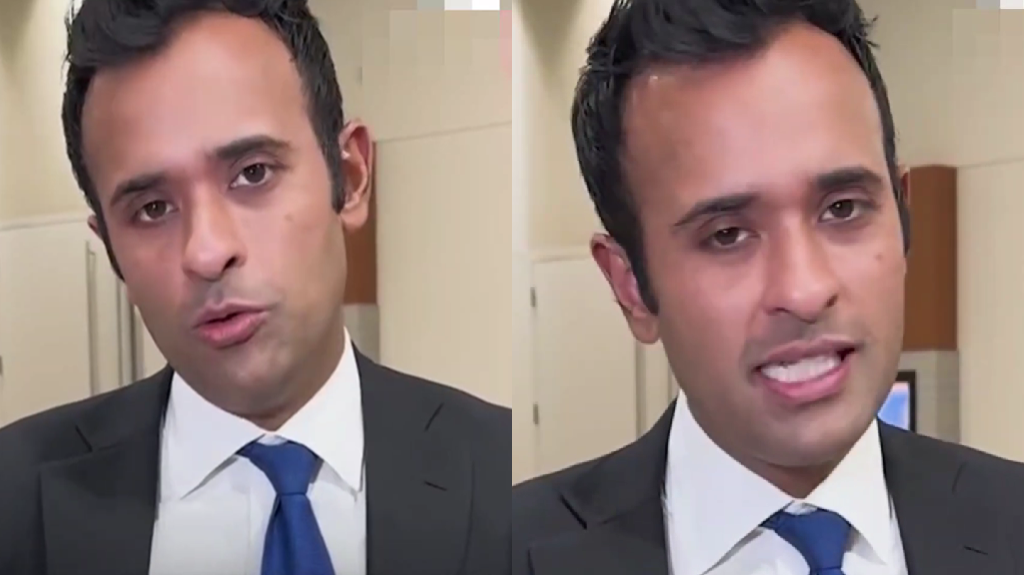
Ohio gubernatorial candidate Vivek Ramaswamy wrote a New York Times essay published Wednesday promoting a large-scale national project, including a moon base, that he hopes would provide Americans with a shared sense of purpose.
The essay also emphasized civic-based definitions of American identity, framing citizenship and constitutional principles as the basis of belonging rather than ancestry or religion. Written amid lingering doubts from Republican voters about his Indian American background and Hindu faith, the essay appears to be a strategic effort to reframe his candidacy and appeal to a party base that has remained skeptical.
Civic identity and divisions on the right
In his essay, the 40-year-old Cincinnati-born son of immigrants from Kerala described two competing visions emerging on the American right: one grounded in lineage and the other in civic ideals. He characterized the lineage-based perspective as focused on ancestry, describing it as “based on lineage, blood and soil: inherited attributes matter most.” He identified the Groyper right, a rising online movement advocating for white-centric identity, as the leading voice of this approach.
Ramaswamy contrasted this with a vision of citizenship defined by adherence to the Constitution, rule of law and freedom of expression. “Americanness isn’t a scalar quality that varies based on your ancestry. It’s binary: Either you’re an American or you’re not. You are an American if you believe in the rule of law, in freedom of conscience and freedom of expression, in colorblind meritocracy, in the U.S. Constitution, in the American dream, and if you are a citizen who swears exclusive allegiance to our nation,” he wrote.
The essay also detailed the hostility he has faced online, with slurs targeting his Indian heritage and calls for deportation. “My social media feeds are littered with hundreds of slurs, most from accounts that I don’t recognize, about ‘pajeets’ and ‘street shitters’ and calls to deport me ‘back to India,’” he wrote.
Economic pressures and generational dynamics
Ramaswamy, an investor and entrepreneur, went on to link identity-based politics to economic pressures affecting younger Americans, including student debt, rising housing costs and uncertainty about retirement. He argued that these conditions contribute to anxiety and depression at historically high levels and foster political tribalism across generations. “In the absence of a shared national identity, they’re turning to tribalism and victimhood instead, Groyperism on the right, Zohran Mamdani-infused socialism on the left,” he observed.
In his essay, he goes on to propose measures intended to alleviate economic pressures while promoting engagement with the country’s economic system. These included increasing housing supply through zoning reform, reducing property taxes, streamlining permitting for energy development and providing every child born in the U.S. with $10,000 invested in the stock market. In his view, such policies could give young Americans tangible stakes in the country’s prosperity, helping to shift political energy toward shared interests.
Ramaswamy also called for ambitious national projects that could inspire collective purpose, writing, “Americans of all stripes long to be reminded of it, through a modern-day equivalent of the Apollo mission. Perhaps it’s establishing a base on the moon to achieve nuclear fusion in a way that powers the creation of artificial intelligence without negative externalities and constraints on Earth.”
Shooting for the moon
Ramaswamy’s essay is a rare and necessary call for moral clarity from within the right, and his framework for a multi-ethnic conservative coalition is a shrewd attempt to pivot the movement away from its most toxic fringe. It is also refreshing to hear him urge Republican leaders to confront racist and exclusionary rhetoric directly. If elected, he would become Ohio’s first Asian American governor.
However, the timing of Ramaswamy’s piece is impossible to overlook. Following an October event where voters questioned whether a Hindu of Indian descent could lead a “Christian state,” and with recent polls showing him in a dead heat with Democrat Amy Acton, the essay feels like a strategic necessity. By leaning into “civic” identity and moon-shot projects, Ramaswamy is attempting to neutralize the fringe of his own base while appealing to the suburban voters he needs to win in Ohio. Ultimately, it remains to be seen if this “moon base” vision can truly unify a party that is still debating whether he belongs in it at all.
This story is part of The Rebel Yellow Newsletter — a bold weekly newsletter from the creators of NextShark, reclaiming our stories and celebrating Asian American voices.
Subscribe free to join the movement. If you love what we’re building, consider becoming a paid member — your support helps us grow our team, investigate impactful stories, and uplift our community.

Join the conversation+