



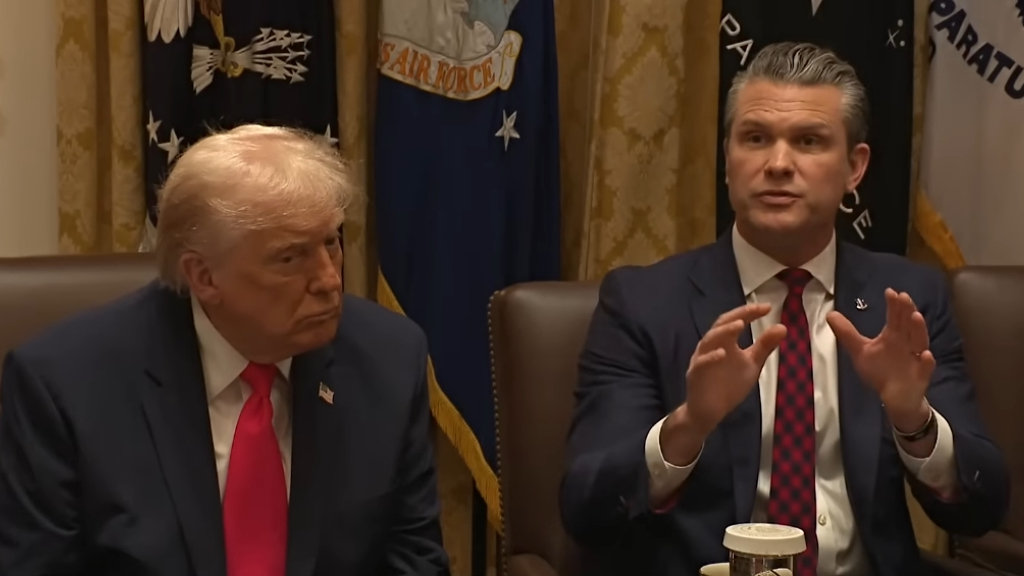
Embattled Defense Secretary Pete Hegseth invoked the “fog of war” during a Cabinet meeting Tuesday to explain his role in a September military strike that killed two survivors floating in Caribbean waters, sparking bipartisan investigations into whether the action constituted a war crime.
State of play: Speaking to reporters, Hegseth acknowledged watching the first strike in real time but said he left for other meetings before learning hours later that Vice Admiral Frank Bradley had authorized a follow-up attack. The double-tap incident on Sept. 2 marked the beginning of an ongoing military campaign that has now reached 22 strikes killing at least 87 people across the Caribbean and eastern Pacific, as Washington has deployed its largest regional force presence in decades, widely seen as pressure against Venezuelan President Nicolas Maduro.
Bradley testified Thursday in closed congressional hearings that no “kill them all” order came from Hegseth, contradicting earlier media reports. The classified briefing nevertheless alarmed lawmakers across parties, with Democratic Rep. Jim Himes (D-Conn.) calling it “one of the most troubling things I’ve seen in my time in public service.” Hours later, the Pentagon announced another strike that killed four people Thursday evening.
Escalating scrutiny: Legal experts have raised serious concerns about the Caribbean strikes. The Pentagon’s own manual on the laws of armed conflict explicitly states “orders to fire upon the shipwrecked would be clearly illegal.” As per The New York Times, retired Australian Army Major General Mick Ryan exposed the logical contradiction of Hegseth’s excuse Wednesday, saying, “If you say you did not have good visibility of the target, the question would be how did you know it presented a threat and why did you engage it?”
A former International Criminal Court (ICC) chief prosecutor previously told the BBC that the strikes constitute crimes against humanity because “these are criminals, not soldiers” and “criminals are civilians.” Senate Armed Services Committee Chairman Roger Wicker and ranking Democrat Jack Reed opened investigations months ago, but the Pentagon has reportedly not complied with document requests dating back to October.
Why this matters: Hegseth’s invocation of “fog of war” carries profound implications for Asian American communities who understand how such language has historically provided cover for military excess. That phrase entered mainstream American consciousness through a 2003 documentary about Robert McNamara’s tenure leading the Defense Department during the Cuban missile crisis and part of the Vietnam War. For families who fled Southeast Asia or mourned relatives killed in that conflict, Hegseth’s rhetoric signals a dangerous willingness to accept ambiguity as justification for lethal force, the same rationale that enabled massacres, free-fire zones and body count metrics that treated civilian deaths as collateral damage.
The parallel becomes sharper when examining what “fog of war” traditionally means versus how Hegseth deployed it. Defense analysts quickly noted how the concept refers to battlefield chaos during active combat, not post-strike surveillance of survivors clinging to wreckage. For Asian Americans whose communities bear generational trauma from Vietnam-era policies that prioritized mission completion over civilian protection, Hegseth’s casual misuse of the term to deflect accountability feels disturbingly familiar.
What’s next: Congressional pressure continues for public release of strike video, which Trump on Tuesday said he supports. The administration defends its actions by characterizing operations as non-international armed conflict with drug traffickers, though the Geneva Conventions prohibit targeting wounded combatants even under that framework. Hegseth, for his part, has shown no intention of changing course. After Thursday’s strike, he taunted critics on social media by telling a supporter, “Your wish is our command, Andrew. Just sunk another narco boat.”
Meanwhile, international legal challenges are emerging. Relatives of Alejandro Carranza, a Colombian man missing since Sept. 14 and presumed killed in the strikes, have filed a complaint with the Inter-American Court of Human Rights in Washington that could expose U.S. personnel to prosecution. Separately, Venezuela has repeatedly condemned the campaign as an attempt to destabilize its government.
This story is part of The Rebel Yellow Newsletter — a bold weekly newsletter from the creators of NextShark, reclaiming our stories and celebrating Asian American voices.
Subscribe free to join the movement. If you love what we’re building, consider becoming a paid member — your support helps us grow our team, investigate impactful stories, and uplift our community.

Join the conversation+