



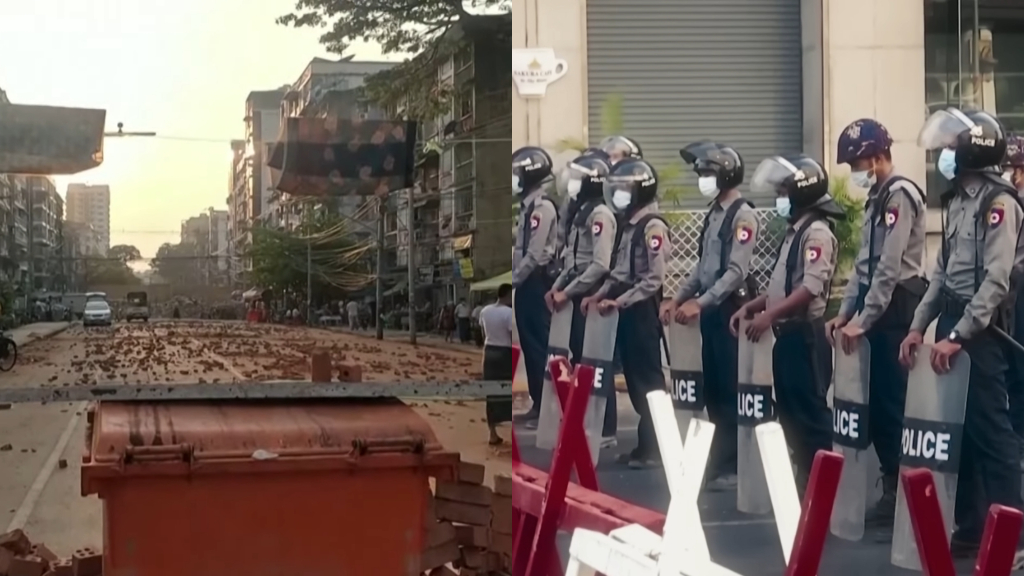
Roughly 4,000 Myanmar nationals in the U.S. face deportation to a war-torn homeland after the Trump administration ended their temporary protected status (TPS) last week, claiming improvements in a country still engulfed in civil war and accused of crimes against humanity.
Policy reversal: Homeland Security Secretary Kristi Noem announced Nov. 24 that protections will end Jan. 26, declaring Myanmar’s situation “has improved enough that it is safe for Burmese citizens to return home.” She cited the country’s “end of its state of emergency, plans for free and fair elections, successful ceasefire agreements and improved local governance” as supporting conditions.
The move, however, is part of what advocates call the largest removal of legal protections in modern U.S. history, affecting hundreds of thousands from Afghanistan, Cameroon, Haiti, Honduras, Nepal, Nicaragua, Syria, Sudan and Venezuela. Three days later on Thanksgiving, Trump claimed on Truth Social that 53 million foreign-born U.S. residents burden taxpayers, describing most as coming from “failed nations, or from prisons, mental institutions, gangs or drug cartels.”
Alarmingly, the justification contradicts the State Department’s own assessments. Its August report on Myanmar documented reports of torture, extrajudicial killings, forced disappearances and other abuses. Its current travel advisory also tells Americans to avoid the country entirely due to armed conflict, arbitrary enforcement of local laws and wrongful detention.
Human cost: Human rights experts are challenging the administration’s rationale. John Sifton, Asia advocacy director at Human Rights Watch, told Reuters that the factual analysis is “fantastical,” saying there have been no improvements in stability and describing the planned elections as a “sham.” Two days after the announcement, the UN’s Independent Investigative Mechanism for Myanmar reported it was increasingly receiving reports of serious international crimes in the runup to the vote. The agency also said detentions of critics and airstrikes may amount to persecution and spreading terror among civilians as crimes against humanity.
The scale of violence is immense. As many as 90,000 people have been killed on all sides since the military’s 2021 coup, according to Armed Conflict Location and Event Data, which tallies media reports. The Assistance Association for Political Prisoners also found that more than 7,400 have been killed by the regime and over 30,000 arrested for political reasons. For those losing protection, the stakes are dire. Phil Robertson, director of Asia Human Rights and Labor Advocates, said the order effectively sends people “back to prisons, brutal torture and death in Myanmar.”
Why this matters: The policy raises fundamental questions about American values. When an administration ignores documented evidence of atrocities to justify deportations, it demands a reckoning with what refuge and compassion actually mean. For Asian Americans, whose communities have experienced exclusionary laws and whose families may have themselves sought protection, the moment poses particular questions about solidarity.
The decision also validates a military regime whose leader, Senior Gen. Min Aung Hlaing, is the subject of a requested International Criminal Court arrest warrant for crimes against humanity tied to persecution of the Rohingya Muslim minority. By portraying controversial elections as legitimate progress while characterizing refugees as burdens, the administration elevates immigration enforcement above human rights and diplomatic consistency. Unsurprisingly, the junta welcomed the move, with spokesperson Major Gen. Zaw Min Tun urging exiles to return and help build what he describes as “a modern, developed and progressive nation.”
The junta’s phased elections begin Dec. 28.
This story is part of The Rebel Yellow Newsletter — a bold weekly newsletter from the creators of NextShark, reclaiming our stories and celebrating Asian American voices.
Subscribe free to join the movement. If you love what we’re building, consider becoming a paid member — your support helps us grow our team, investigate impactful stories, and uplift our community.

Join the conversation+