



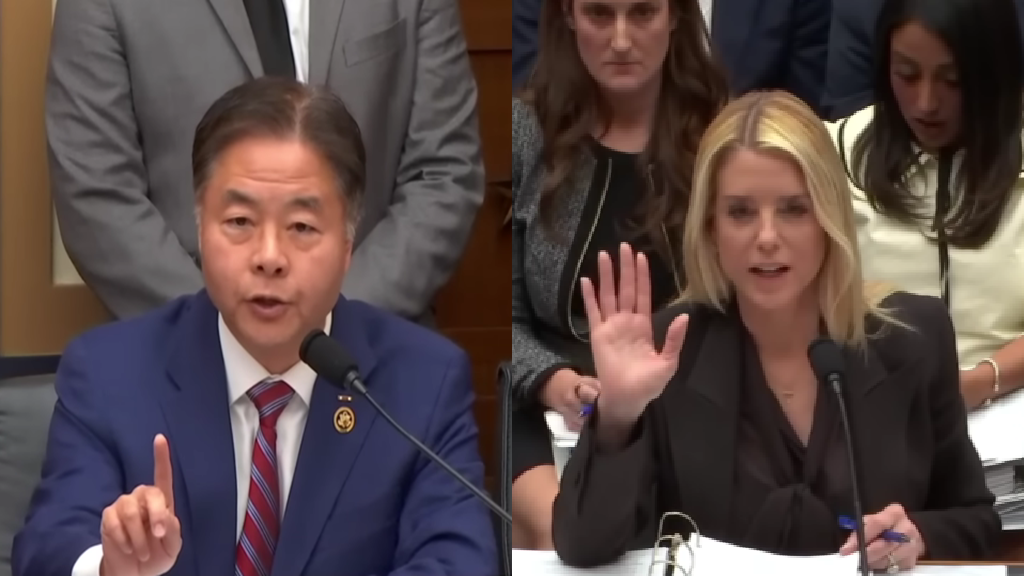
Questions over redactions, prosecutorial decisions and victim protections dominated Wednesday’s House Judiciary Committee hearing in Washington, where Rep. Pramila Jayapal (D-Wash.) and Rep. Ted Lieu (D-Calif.) joined other members of Congress in grilling Attorney General Pam Bondi over the Justice Department’s handling of the Jeffrey Epstein files during several hours of contentious testimony.
Lieu accused Bondi of lying under oath after she said investigators found no evidence to pursue charges against uncharged third parties, while Jayapal pressed her to apologize directly to survivors present in the hearing room.
Allegations of false testimony
The sharpest exchange unfolded after Bondi defended a July 2025 Justice Department memo stating, “We did not uncover evidence that could predicate an investigation against uncharged third parties.” The memo has drawn scrutiny from Democrats who argue the department prematurely ruled out additional prosecutions tied to Epstein’s trafficking network.
During questioning about individuals referenced in the files, Bondi said there was “no evidence that Donald Trump has committed a crime.” Lieu immediately responded, “I believe you just lied under oath.” Bondi shot back, “Don’t you ever accuse me of a crime.” Lieu reiterated his charge, telling her, “I got your answer. You said there’s no evidence,” before repeating, “I believe you just lied under oath and this is all on videotape.”
As his time expired, Lieu broadened his criticism. “You have the power to change things to hold these men accountable. And you’re doing the opposite. You’re protecting them,” he said. He added, “There are over 1,000 sex trafficking victims and you have not held a single man accountable,” concluding, “If you had any decency, you would resign right after this hearing concludes.”
The confrontation came amid renewed congressional scrutiny of the Justice Department’s release of millions of pages of Epstein-related records. Congress passed the Epstein Files Transparency Act requiring disclosure of information tied to perpetrators while mandating redactions to protect survivors. Bondi, who assumed office after the law’s passage, has overseen the department’s compliance with those requirements, including decisions regarding redactions and the July 2025 determination not to pursue charges against uncharged third parties.
Survivor impact and redaction concerns highlighted
Earlier in the hearing, Jayapal focused on how the department handled victim privacy and communication with survivors. She argued that while certain names of powerful figures were redacted, some survivor information was released.
Addressing survivors seated behind her, Jayapal said, “If you are willing, please stand. And if you are willing, please raise your hands if you have still not been able to meet with this Department of Justice.” She then stated for the record that “every single survivor has raised their hand.”
Jayapal asked Bondi directly, “Will you turn to them now and apologize for what your Department of Justice has put them through with the absolutely unacceptable release of the Epstein files and their information.” After Bondi referenced prior department leadership, Jayapal responded, “This is not about anybody that came before you. It is about you taking responsibility for your Department of Justice and the harm that it has done to the survivors who are standing right behind you.”
She later described the department’s actions as “a massive coverup,” adding, “I wish you would turn around to the survivors who are standing right behind you and on a human level recognize what you have done.” Bondi responded that she would not “get in the gutter for her theatrics.”
Unresolved questions about DOJ credibility remain
The hearing came days after a group of lawmakers were granted access to portions of previously unredacted Epstein-related files in a secure setting on Capitol Hill. Throughout the hearing, several lawmakers challenged whether the Justice Department had fully examined potential misconduct by powerful individuals named in the files and questioned the department’s internal review process.
Bondi frequently deflected criticism by referencing actions taken under prior attorneys general and defending the department’s compliance with the Epstein Files Transparency Act. The session ended with Bondi maintaining that the department had followed the law and conducted a thorough review, while Democratic members signaled they were unconvinced by her explanations.
This story is part of The Rebel Yellow Newsletter — a bold weekly newsletter from the creators of NextShark, reclaiming our stories and celebrating Asian American voices.
Subscribe free to join the movement. If you love what we’re building, consider becoming a paid member — your support helps us grow our team, investigate impactful stories, and uplift our community.

Join the conversation+