



Immigration and Customs Enforcement (ICE) agents continue aggressive door-to-door operations in Minnesota, using racial profiling to target Asian American communities in an escalating crackdown that has made over 2,000 arrests statewide since early December and over 10,000 arrests in Minneapolis alone.
What we’re seeing: ICE operations in Minnesota have expanded far beyond their stated focus on the Somali community to systematically target Asian Americans, particularly Hmong residents. St. Paul Mayor Kaohly Her, the first Hmong American to serve in the role, testified before Congress Friday that residents reported agents “going door-to-door asking people where the Asian people live” in the city. The administration has openly embraced this approach, with Vice President JD Vance announcing on Fox News that “we’re going to see those deportation numbers ramp up as we get more and more people online working for ICE, going door-to-door.”
Needless to say, fear has disrupted daily life across the region. St. Paul Public Schools shifted to e-learning for a month after immigration agents deployed tear gas on students and children, while business owners reported revenue declines reaching 60%. The crackdown has also drawn international scrutiny, with Korean broadcaster KBS sharing videos of masked agents breaking into homes as residents protested with car horns and whistles.
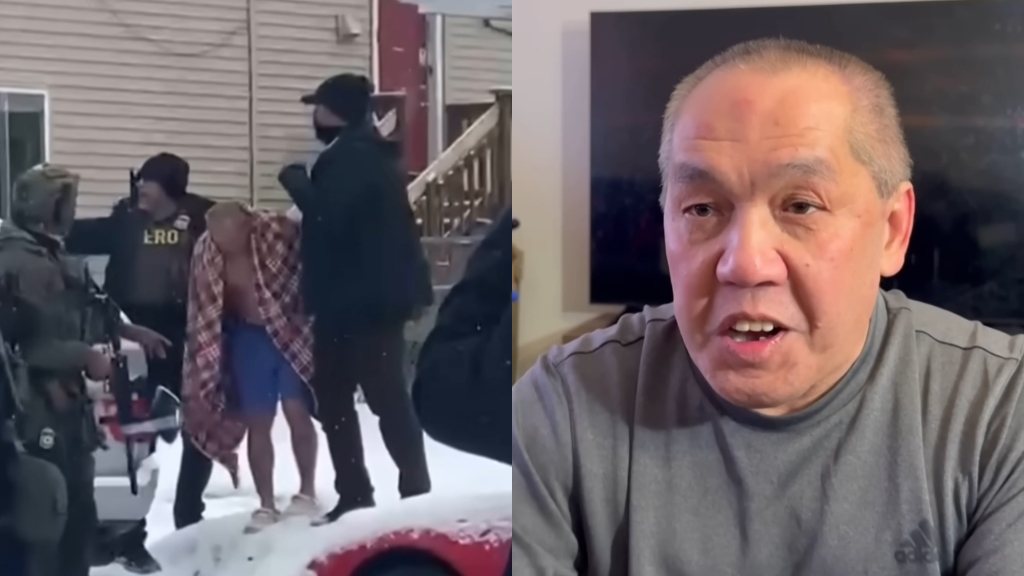
Alarming incidents: On Sunday, federal agents forced their way into ChongLy “Scott” Thao’s St. Paul home without a warrant, detained him at gunpoint and led him into subfreezing weather wearing only underwear and sandals as his 4-year-old grandson watched and cried. “They didn’t show any warrant; they just broke down the door,” Thao told the Associated Press. Agents transported him to an isolated area, forced him from the vehicle in freezing temperatures for photographs, then brought him back hours later without apology once they verified his citizenship and absence of criminal history. Thao’s adopted mother had fled Laos after working as a nurse treating CIA-backed Hmong soldiers during America’s “Secret War” from 1961 to 1975, forced to escape when her support for U.S. operations put her life in danger.
The pattern extends across neighborhoods. Kong Vang recorded agents at his Frogtown door demanding entry while he sheltered inside with his parents, who immigrated from Laos during the 1970s. All of them are citizens. In another incident, two men with Homeland Security badges asked Elizabeth Lugert-Thom to identify “where the Hmong families lived” on her North End street, then requested information about “the Asian families” when she said she did not know, the Chicago Tribune noted. On Instagram, St. Paul Council Vice President HwaJeong Kim, who represents Lugert-Thom’s ward, reported that ICE had already kidnapped someone from said ward before 9:30 in the morning early last week. She said agents were “asking them to identify people in pictures,” and when residents failed to recognize them, they questioned, “Do you know any of your Hmong neighbors?”
What this means: The situation in Minnesota represents an alarming expansion of immigration enforcement into constitutionally protected territory through explicit racial profiling. When federal agents ask residents to identify neighbors by ethnicity, they’re not conducting targeted law enforcement, but ethnic sweeps that endanger anyone who appears Asian regardless of citizenship status. Mayor Her’s warning that she carries her passport because “they may try to target me based on what I look like” reveals the reality facing communities across the state: that citizenship offers no protection when enforcement relies on racial appearance.
The numbers underscore the operation’s overwhelming scale. Over 2,400 DHS agents have been deployed to the Twin Cities, outnumbering the city’s police force by a ratio exceeding two to one. While federal authorities tout arrests of individuals with criminal records, cases like Thao’s expose how quickly “targeted enforcement” becomes indiscriminate dragnet operations. Adding to the operation’s contradictions, the fatal Jan. 8 shooting of Renee Good was carried out by agent Jonathan Ross, who himself is married to a Filipino immigrant.
What you can do: Know your rights. You are not required to open your door or answer questions without a warrant signed by a judge. Document everything, share information with trusted community networks and report incidents to local council members and advocacy organizations. Support affected families through mutual aid efforts and fundraising campaigns. Pressure elected representatives to condemn racial profiling and demand accountability for warrantless entries. Stay connected with your community through neighborhood watch networks that monitor ICE activity and provide real-time safety information.
This story is part of The Rebel Yellow Newsletter — a bold weekly newsletter from the creators of NextShark, reclaiming our stories and celebrating Asian American voices.
Subscribe free to join the movement. If you love what we’re building, consider becoming a paid member — your support helps us grow our team, investigate impactful stories, and uplift our community.

Join the conversation+