



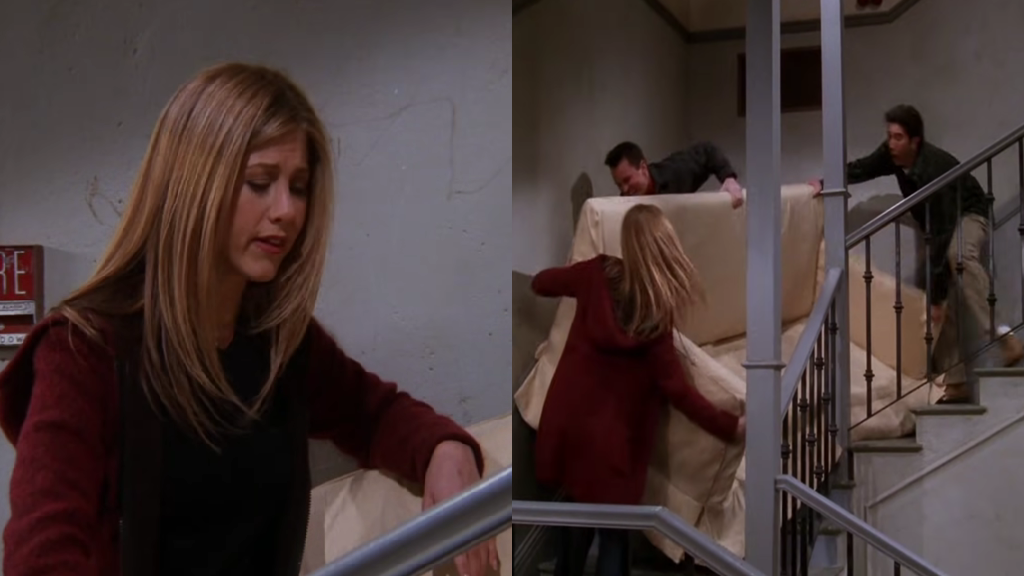
The “moving sofa problem,” a puzzle that has remained unresolved since it was introduced in 1966 and memorably illustrated in the sitcom Friends, may finally have an answer. Baek Jin-eon, a 31-year-old research fellow at the Korea Institute for Advanced Study, has produced a proof showing that no shape with an area greater than approximately 2.2195 square units, measured relative to a corridor of unit width, can complete the turn. The research was named one of the top 10 mathematical breakthroughs of 2025 by Scientific American.
The paper that sets the upper limit: Baek detailed his findings in a 119-page paper titled Optimality of Gerver’s Sofa, released as a preprint in late 2024. His result establishes the optimality of the curved figure known as Gerver’s sofa, after mathematician Joseph Gerver, who proposed it in 1992. The paper argues that any rigid planar shape exceeding Gerver’s area must violate the movement constraints at some point while attempting to navigate a right-angled corner. Baek described how the problem appealed to him, saying, “This sofa problem doesn’t have much historical context, and it wasn’t even clear whether there was theory behind it. I tried to connect it to existing ideas and turn it into an optimisation problem, creating tools suited to the question.” The work is undergoing peer review, the standard process for validating major mathematical results.
A problem defined by tight constraints: First posed by mathematician Leo Moser in 1966, the moving sofa problem asks for the largest possible rigid two-dimensional shape that can be slid and rotated around a 90-degree corner in an L-shaped corridor of constant width. In the standard formulation, the corridor width is fixed at one unit so that all candidate shapes can be compared using the same scale of area. The problem entered popular culture through a 1999 “Friends” episode in which characters attempt to move a couch up a narrow stairwell, repeatedly pivoting it before it becomes stuck at the corner, reflecting the same geometric limitations studied by mathematicians.
Why Gerver’s sofa mattered: In 1992, Gerver introduced a highly intricate curved shape that successfully made the turn while achieving an area of about 2.2195 square units. The construction relies on a precise sequence of rotations that keep different parts of the shape in contact with the corridor walls throughout the maneuver. While no larger shape had ever been shown to succeed, Baek’s proof is the first to argue rigorously that no such improvement is possible.
This story is part of The Rebel Yellow Newsletter — a bold weekly newsletter from the creators of NextShark, reclaiming our stories and celebrating Asian American voices.
Subscribe free to join the movement. If you love what we’re building, consider becoming a paid member — your support helps us grow our team, investigate impactful stories, and uplift our community.

Join the conversation+