



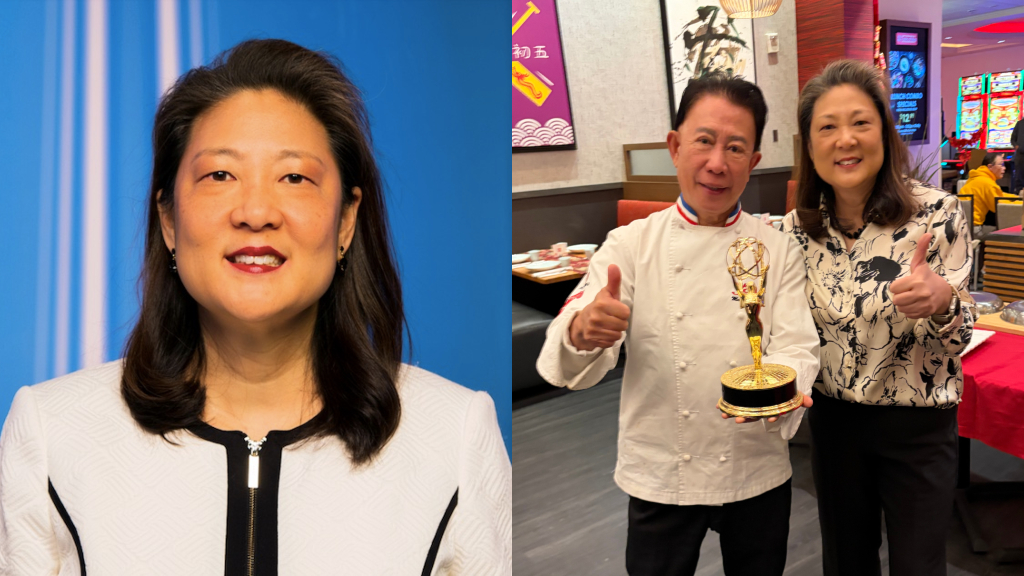
A lawsuit by a former Chinese American employee has exposed allegations of systemic racism at a local PBS station, just as the publicly funded national broadcaster dismantles its diversity infrastructure and, she says, external oversight vanishes.
Dream job turned nightmare
Terry Chi thought she had landed her dream job in 2022 as director of marketing at Vegas PBS, especially after recalling how shows like “Mr. Rogers” and “Sesame Street” had helped her learn English as a child. After three decades in corporate America, she expected the public broadcaster to live up to its reputation for valuing diversity.
In an exclusive interview with The Rebel Yellow, Chi instead describes a workplace where “institutional racism, race-based exclusion and financial improprieties” were rampant. Within months of her hire, she says she was asked to oversee an additional department, doubling her workload in what supposedly violated her union contract. After six months without compensation for the added responsibilities, she says Vegas PBS President Mare Mazur promoted a white colleague who had assumed no extra duties.
When Chi advocated for fair pay via email, she says she received her first “unprofessional” warning and was told Mazur “did not see a future” for her at the station. “I wondered why I was so competent as to be given another department to manage, only to not have a future there,” she questions.
A critical turning point came in May 2022 when she delivered a presentation to the station’s board. Afterward, board treasurer Kim Walker, who was also Mazur’s college roommate, reportedly remarked, “Terry’s presentation is great. I wouldn’t want to meet her in a back alley!”
Chi identified the comment as loaded with racial and gender bias, but Mazur allegedly told her to take it as a compliment. Alarmingly, her refusal purportedly triggered what she describes as relentless retaliation: 16 written warnings over a year, three investigatory hearings, demotion, suspension notice and ultimately termination when her contract wasn’t renewed in June 2024. “I pleaded with my union reps and HR at least 121 times in writing to please stop the illegal retaliation,” Chi shares. “I wrote: ‘Their goal is to bully me to death so that I suffer a stroke or heart attack.’”
She recalls interviewing former employees who described a pattern. Allegedly, Black women were denied promotions despite extra work, while Asian American women were vilified as aggressive “dragon ladies.” This reportedly extended to retaliation as well. “It is a fact that no newly hired woman or person of color has made it past the three-year probation period under Vegas PBS President Mare Mazur,” she alleges.
What Chi describes as retaliation extended beyond the workplace. She claims Vegas PBS threatened to arrest her for criminal trespassing if she entered her workplace or attended the national PBS annual conference. The ordeal, she says, resulted in multiple medical leaves for vertigo, heart palpitations, high blood pressure and insomnia. The intimidation allegedly continued even at public events, with a video of security guards confronting her at the PBS annual conference available on her YouTube channel.
In response to what she describes as systemic abuse, Chi sued Vegas PBS in fall 2024 in federal court for race, gender, age, and ADA discrimination, and in state court for defamation.
The story nobody wants told
Chi’s core claims of retaliation, race discrimination, age discrimination and disability discrimination are proceeding to discovery after a federal judge dismissed some secondary claims last August, including her request for reinstatement and sex discrimination allegations. The state defamation case has been settled. “All the major tenets of my federal lawsuit are moving forward,” she says.
However, her legal battle is only one front in a broader effort to expose systemic problems. Her attempts to expose broader patterns at PBS member stations have met resistance.
She reportedly connected with Julian Wylie of Current, an industry newsletter for public media professionals, in March 2024. Wylie, she says, had committed to investigating whistleblower stories from about a dozen former and current employees who experienced racism and discrimination under Mazur at both Vegas PBS and Arizona PBS.
Mysteriously, the story was scrapped.
Chi cites text messages, shared to her by another whistleblower, from Current Executive Director Julie Drizin sent during a Jan. 9, 2025 Zoom meeting that read, “Our culture (reinforced by CPB) is that you don’t air dirty laundry in public. That’s why station leaders don’t want to jeopardize their relationship (funding) from CPB or fuel the forces that want to defund public media.”
The revelation apparently confirmed Chi’s suspicions about why the story was not published. “We entrusted Current with our stories, re-lived our traumas by re-telling them and believed in the publication’s journalistic integrity,” she points out. “Not only was it a huge waste of time and a violation of our trust, I will never believe in public media’s ability to do accurate, investigative journalism again.”
The pattern of suppressing negative stories, however, was not new to Chi. As marketing director, she says she witnessed censorship firsthand: negative stories about the Clark County School District (CCSD), Vegas PBS’ broadcast license holder, were axed, while production resources created what she calls “positive propaganda” for the district.
Chi’s experience with Current mirrors what she describes as a broader culture of silence within public broadcasting. When internal complaints go unaddressed and external journalism refuses to investigate, she argues, accountability disappears entirely, leaving employees of color with nowhere to turn when discrimination occurs at member stations.
When oversight vanishes
Chi recalls contacting multiple national PBS departments, including the chief diversity officer, seeking intervention. But all declined, citing what she was warned would be their standard response of avoiding legal liability.
Last February, PBS shuttered its diversity, equity and inclusion (DEI) office entirely under Trump administration pressure, which Chi saw as a signal that diversity was not a priority. “The fact that PBS’s leaders so quickly caved demonstrates to me how DEI was just ‘window dressing,’” she notes.
What troubles her even more is what she describes as a pattern of leadership failures being rewarded rather than punished. She draws parallels to the Catholic Church abuse scandal, alleging that Mazur was terminated from previous positions before being hired at Vegas PBS.
“When Mare Mazur was terminated from KCET in Los Angeles due to financial improprieties, and then terminated from Arizona PBS after employees of color wrote a letter of complaint to Arizona State University officials, and then only to be hired at Vegas PBS to repeat the same abuse, it’s analogous to elements of the Catholic Church sexual abuse scandal,” she compares. “We need investigative journalists with the same tenacity and courage to break this PBS abuse story in the national news.”
Chi sees a trend of failed PBS executives moving between stations, and questions CEO Paula Kerger’s accountability. Kerger, of course, has led PBS for roughly 20 years, earning over $1 million annually while maintaining that local stations operate independently. “What responsibility does she have to the employees who work under its umbrella?” Chi asks. “At the end of the day, it’s their brand on all our buildings.”
According to Chi, PBS’ internal oversight was already failing, and external oversight has now vanished entirely. She says the Corporation for Public Broadcasting (CPB), which handles whistleblower complaints through its Inspector General’s Office, was shut down on Jan. 5, 2026. “When public media’s own oversight body vanishes, who will protect the people who speak up — and the communities whose money and trust are at stake?” Chi questions.
Those communities have significant financial stakes in Vegas PBS, which was poised to lose nearly $4 million in federal funding last year after Trump administration cuts — though Chi maintains it relies heavily on other sources, including from the nonprofit Southern Nevada Public Television (SNPT). In 2023, for instance, the station received 88% of its $14.4 million budget from local funding, with only 12% coming from the CPB.
“It’s troubling that taxpayer dollars are being used to carry out illegal, retaliatory tactics that discriminate against people of color and women,” Chi stresses. “What’s left now is an all-white senior leadership team that does not reflect the Southern Nevada communities it serves.”
Fighting for change
Beyond what Chi describes as institutional failures at Vegas PBS, her experience illuminates broader discrimination patterns facing Asian Americans in professional settings. Raised to believe meritocracy would drive advancement, she instead encountered different, disappointing realities.
“My Chinese immigrant parents told me to focus on my education and to work harder,” she shares. “We focused on being competent instead of being seen as leadership material.” When she did advocate for herself, she was labeled “aggressive” — tone-policing she identifies as a racist tactic creating “a no-win situation for Asian American women especially.”
Over one year, she received those 16 write-ups for “unprofessionalism,” a subjective term she calls “a legal loophole that workplace bullies use to create false narratives.” She discovered that Asian Americans often are not viewed as people of color or as disadvantaged in workplaces. “Few know about the history of Asian Americans being enslaved, discriminated against and sent to internment camps in this country’s recent history,” she stresses.
Apart from historical ignorance, there are present-day stereotypes at play. Implicit biases about wealth, like seeing Asian Americans drive luxury cars, can mean being stereotyped as not needing raises. Chi says she experienced this firsthand. She notes that when she tried educating Vegas PBS leadership about offensive statements, it “triggered their fear of being ‘cancelled’ for having their racism publicly exposed. Instead of listening and learning, their response was to play the victim and to discredit me.”
Rather than let the experience defeat her, Chi has channeled it into advocacy. She now serves as Nevada state bill director for End Workplace Abuse, a national nonprofit working to make workplace bullying illegal. She’s advocating for two legislative changes: passing a Workplace Psychological Safety Act and reducing CCSD’s three-year probation period for professional employees to match other government jobs.
She cites a 2023 Harris Poll that shows 71% of U.S. workers have experienced toxic supervisors, and nearly one in three working under toxic management. Chi sees her experience reflected in these numbers. “Toxic bosses are rewarded, not reprimanded, showcasing the institutional complicity,” she says.
“PBS is no different from any other workplace in America,” she emphasizes. “This is what will be disappointing for your readers to learn. My goals are to not only seek justice in my own case, but to ensure that publicly funded institutions treat employees lawfully and equitably, and that whistleblowers are protected, not punished.”
The Clark County School District declined to comment on this story citing pending litigation.
This story is part of The Rebel Yellow Newsletter — a bold weekly newsletter from the creators of NextShark, reclaiming our stories and celebrating Asian American voices.
Subscribe free to join the movement. If you love what we’re building, consider becoming a paid member — your support helps us grow our team, investigate impactful stories, and uplift our community.

Join the conversation+