



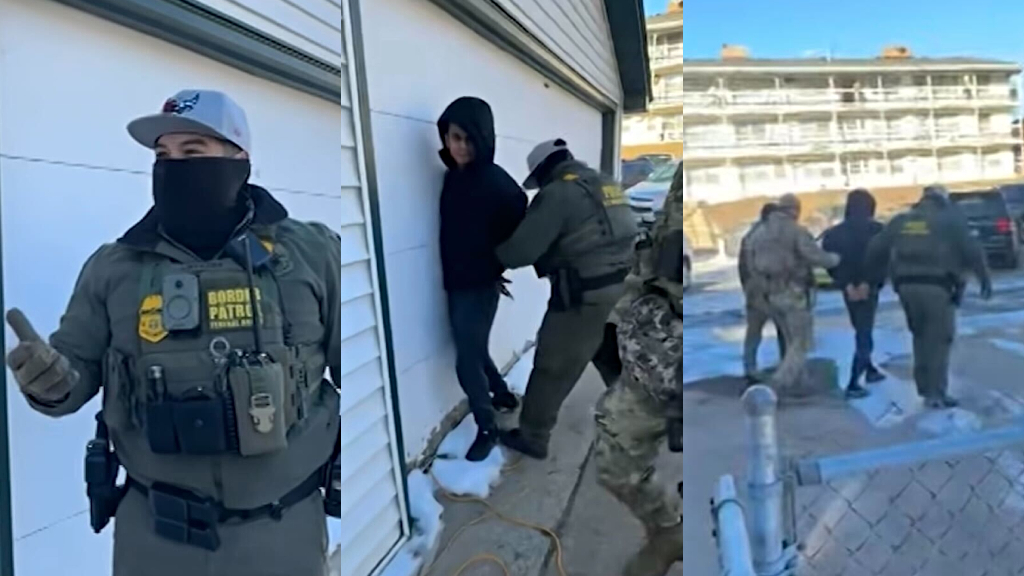
Border Patrol agents detained a U.S. passport holder based solely on his accent in Minneapolis last week, raising concerns about expanded racial profiling that threatens Asian American communities.
What happened: The arrest, which was caught in a now-viral video, occurred just outside Ramon Menera’s home in Minneapolis last Wednesday. When he questioned why the agents wanted his identification, one bluntly responded, “because of your accent.” Menera then pointed out the agent’s own accent, resulting in an escalation that ended with him being restrained and taken into custody. However, agents freed him once their database confirmed that he holds a U.S. passport card issued in 2021, though he was born in Mexico. The incident unfolded before his 5-year-old daughter, who watched through a window and now fears leaving the home, CNN reported.
What this means: Though enforcement actions have primarily targeted Latino communities, the implications reach far beyond. Last September, the Supreme Court authorized immigration enforcement to weigh ethnicity alongside other considerations during stops, establishing a legal framework that puts Asian immigrants at risk.
The geographic scope is also expanding. Operations “Midway Blitz” in Chicago and “Patriot 2.0” in Boston are underway in metropolitan areas with substantial Asian American populations. Rep. Ilhan Omar (D-Minn.) reported that agents are conducting stops at commercial areas and residential neighborhoods, often without clear legal basis. Justice Sonia Sotomayor warned in her Supreme Court dissent that the ruling renders certain groups vulnerable to being “seized at any time” based on ethnicity and employment, a reality now playing out in communities nationwide.
Legal concerns: The constitutional issues are clear. Demanding papers based on accent alone breaches Fourth Amendment protections against unreasonable searches, legal analysts say. CNN analyst Elie Honig explained that Justice Brett Kavanaugh reaffirmed in September 2025 that agents need reasonable suspicion, a threshold requiring articulable justification beyond arbitrary characteristics like appearance or speech. This means officers must explain specific reasons for a stop, not simply point to how someone looks or sounds.
However, Secretary Kristi Noem said last week that enforcement complies with law and recommended citizens carry citizenship proof. The evidence tells a different story. In Minneapolis alone, ICE agents fatally shot Renee Good, a white woman and a U.S. citizen, as she attempted to drive away. The ACLU responded by filing a class-action suit Jan. 15, alleging systematic Fourth Amendment violations through racial profiling and warrantless arrests.
What to do: Understanding your constitutional rights is essential. Agents cannot legally stop you without reasonable suspicion that goes beyond appearance or how you speak. Street encounters and doorstep visits don’t obligate you to answer immigration questions or present documentation. You can simply ask whether you’re free to leave. Agents cannot enter your home without a warrant signed by a judge. If confronted, record interactions safely when possible, note badge numbers and specific statements, and report incidents to civil rights organizations like the ACLU.
This story is part of The Rebel Yellow Newsletter — a bold weekly newsletter from the creators of NextShark, reclaiming our stories and celebrating Asian American voices.
Subscribe free to join the movement. If you love what we’re building, consider becoming a paid member — your support helps us grow our team, investigate impactful stories, and uplift our community.

Join the conversation+