


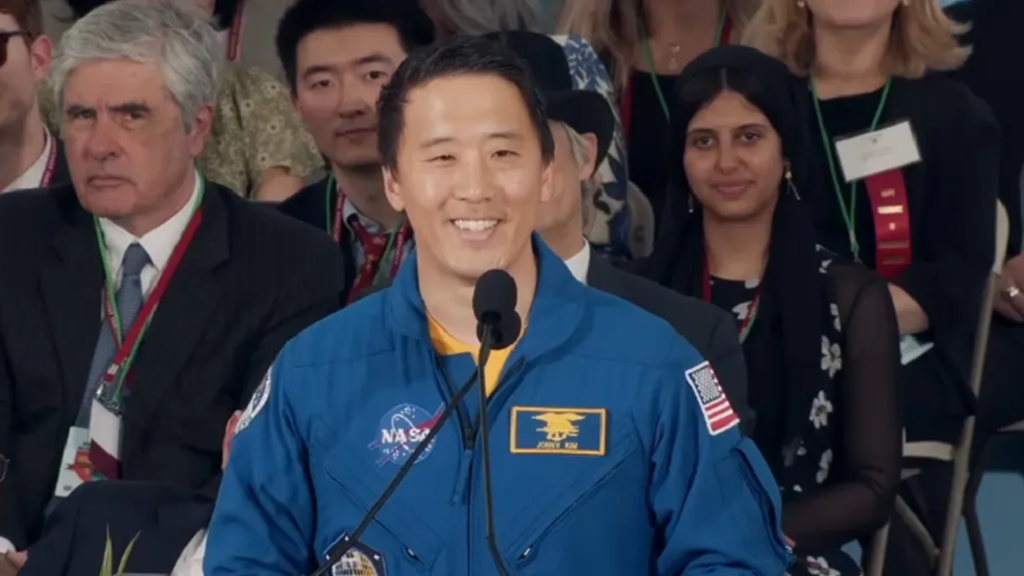
Jonny Kim has spent his adult life in some of the world’s most demanding professions, serving as a Navy SEAL, earning a medical degree from Harvard and spending eight months aboard the International Space Station. Yet before more than 9,000 alumni gathered for Harvard Alumni Day, Kim used his keynote address to challenge one of the ideals that drew him into military service. “The solo hero myth is dangerous,” he said.
The son of South Korean immigrants, Kim, 42, spent much of the address reflecting on failure, trauma and loss rather than the accomplishments that made him one of Harvard’s most recognizable alumni.
Rejecting the hero Kim wanted to become
Kim opened by reflecting on a childhood fascination with comic-book superheroes. As a boy, he said, he wanted to become “the incorruptible self-reliant Batman fighting injustice.”
The image remained powerful as he entered the military, but years spent in combat, medicine and spaceflight reshaped his understanding of strength and service. “Whether you’re relying on the Marine next to you in a firefight, the nurse during a code blue, or your crewmates in the vacuum of space, survival demands absolute trust in others,” he said.
Instead of celebrating self-reliance, Kim described trust as a necessity in environments where mistakes can carry life-or-death consequences. “True strength is found in recognizing you cannot do this alone,” he added.
Redefining strength through empathy
Kim identified himself as “the son of immigrants who came to this great country to build a better life for their children.” He said the Sept. 11 attacks during his high school years reinforced his desire to serve, eventually leading him to the Navy SEALs.
Years later, he reflected on a combat decision that resulted in a death. Although an investigation concluded he had acted within the rules of engagement, Kim said the experience remained a burden. “I’m not the victim of this tragedy. I caused it.”
What ultimately challenged his understanding of strength, he said, was not self-reliance but empathy. Crediting classmates and professors who helped him through trauma, he described the experience as a lesson that “empathy and vulnerability are superpowers that can heal.”
Kim’s ultimate superhero
Reflecting on his recent mission aboard the International Space Station, Kim recalled seeing “epic storms, volcanic eruptions, vast oceans, and cities glowing like constellations.”
“Through it all, I never saw distinct borders,” he said. “I just saw a fragile, beautiful planet suspended in the darkness of our solar system.” The experience brought what Kim called “the overwhelming realization that everyone you have ever known and will ever love shares the same spaceship we call Earth.”
Near the end of the address, he revealed that his mother had died from cancer about a month earlier. He remembered her as compassionate, generous and “above all, morally courageous.”
“And my whole life, I’ve looked to fictional characters or out into the world for heroes to emulate when my biggest superhero was always right there by my side,” he said. “Mom, I love you and I wish I had told you that you were my superhero.”
This story is part of The Rebel Yellow Newsletter — a bold newsletter from the creators of NextShark, reclaiming our stories and celebrating Asian American voices.
Subscribe free to join the movement. If you love what we’re building, consider becoming a paid member — your support helps us grow our team, investigate impactful stories, and uplift our community.

Join the conversation+