



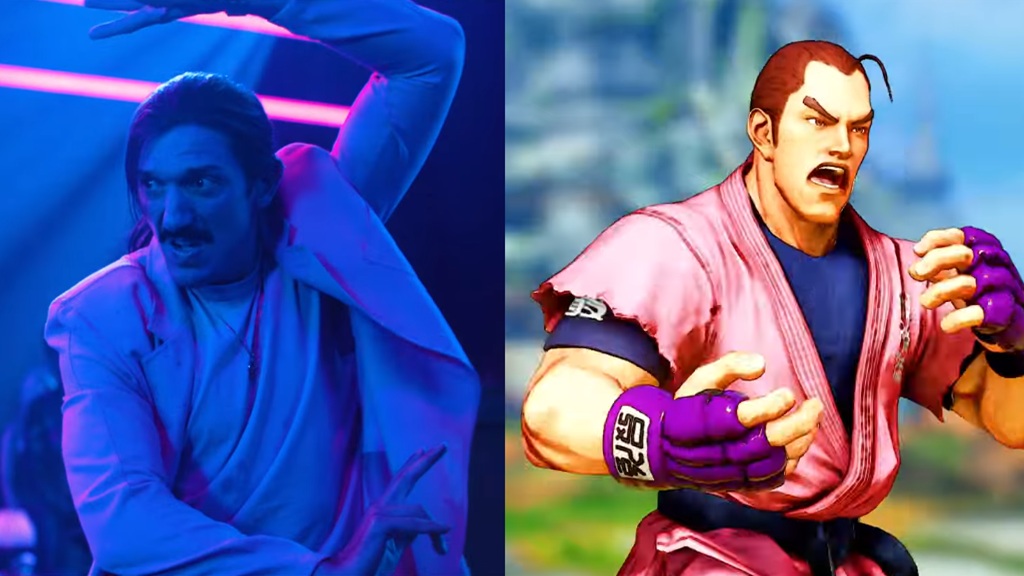
As the “Street Fighter” film enters its marketing phase following the teaser trailer debut at the 2025 Game Awards, renewed scrutiny has fallen upon a casting decision announced earlier in the year. While the film embraces a fun, self-aware tone with campy action and over-the-top sequences, comedian Andrew Schulz’s casting as Dan Hibiki, a legacy character whose origins are explicitly Japanese, stands out as its weakest element.
Directed by Kitao Sakurai and produced by Legendary Entertainment, “Street Fighter” adapts a franchise defined by nationality, lineage and martial arts tradition. While the ensemble features several well-aligned castings, the inclusion of Schulz departs from the source material’s cultural grounding and underscores the ongoing issue of how studios treat Asian characters in legacy franchises.
The provocation of Schulz’s casting
Dan Hibiki was introduced in 1995 in “Street Fighter Alpha: Warriors’ Dreams” as a parody of the self-important fighters popular in Japanese arcade culture. Although his role is comedic, Dan’s identity is rooted in a specific Japanese urban archetype. He is portrayed as the son of a Japanese martial artist and trained in Saikyo-ryu, which is a deliberately flawed offshoot of Ansatsuken (the same fighting style practiced by Ryu and Ken). Across multiple iterations, Dan’s Japanese identity has remained intact despite his comic function. Casting Schulz, a white American with no Asian heritage, removes that cultural grounding and erases the very foundation of the character’s satire.
In a franchise where nationality and martial lineage are central, this choice stands out, particularly when the chosen actor has frequently targeted the Asian community. In his 2020 Netflix special “Schulz Saves America,” the proudly anti-woke comedian faced intense backlash for jokes that leaned into harmful stereotypes. Most notably, he referred to the coronavirus as an “Asian parasite,” leading critics to accuse him of fanning the flames of anti-Asian sentiment. Bringing in a performer known for disparaging the very culture his character originates from creates an uncomfortable friction that the film’s marketing has yet to address.
Selective authenticity and narrative blind spots
The 2025 teaser showcases a vibrant world, but it also reveals a selective approach to authenticity that weakens the ensemble. While Andrew Koji’s Ryu and Callina Liang’s Chun-Li are faithfully cast, other lead roles are significant misses. Noah Centineo’s casting as Ken Masters is a prime example. Ken is canonically three-quarters American and one-quarter Japanese, yet the production chose a white actor with no Japanese lineage, obscuring the vital connection between Ken and Ryu.
Haven’t Hollywood learned anything from past casting missteps for roles tied to specific character origins? Justin Chatwin’s portrayal of Son Goku in “Dragon Ball Evolution” (2009) drew widespread criticism for straying from the source material and failing to capture the essence of the iconic anime hero. Similarly, Scarlett Johansson’s casting as Major Motoko Kusanagi in “Ghost in the Shell” (2017) raised questions about how it diverged from the character’s original Japanese identity.
While Centineo’s casting feels like your typical Hollywood “oversight,” Schulz’s presence is far more egregious due to his history of cultural insensitivity. Decoupling Dan from his Japanese roots to accommodate a controversial figure emerges as the film’s most significant narrative blind spot.
This story is part of The Rebel Yellow Newsletter — a bold weekly newsletter from the creators of NextShark, reclaiming our stories and celebrating Asian American voices.
Subscribe free to join the movement. If you love what we’re building, consider becoming a paid member — your support helps us grow our team, investigate impactful stories, and uplift our community.

Join the conversation+